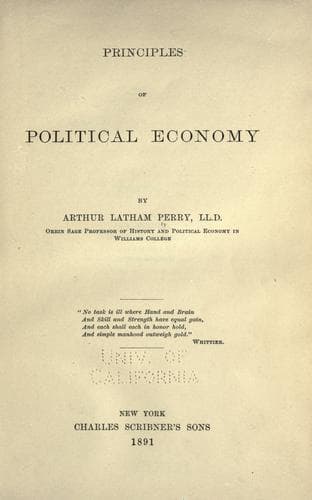
Principles of Political EconomyPerry, Arthur Latham
General
Principles of Political Economy
Perry, Arthur Latham
Economics
The two Banks of the United States in succession, as they were more or
less modelled after the Bank of England, gave the same prominence to
the function of issuing paper money, under the belief that government
bonds afford the best security for the redemption of bank bills, an
idea that underlies our present system of National Banks also; and,
moreover, those two great banks began to teach the people of the
United States something of the mysteries of _Deposit-banking_, the
point that we have now in hand. One-fifth of the capital stock of the
first Bank, $2,000,000 out of $10,000,000, was subscribed by the
national Government; and besides, the proceeds of the national taxes
as they were paid in were passed over to the Bank as _Deposits_, that
is to say, the Bank bought this money of the Government, paying for it
with a Credit; and then properly used the money as its own in paying
expenses and in discounting paper. Bank deposits do not belong to the
depositors, but to the bank; which has thus bought money with credit;
and when Andrew Jackson suddenly removed from the second Bank of the
United States the national moneys deposited there, and placed them "in
the custody," as he expressed it, of certain selected State banks,
these amounted at the moment to $10,000,000, and the discount line
resting in part on these deposits was at the time over $60,000,000, he
removed them under a strong misapprehension _of the nature of such
deposits_; and their _removal_ affected credit, and disarranged
business to a remarkable degree, and caused intense excitement all
over the Union. Depositing those national moneys with the Bank was a
_trade_ between the Government and the Bank for the time being. The
Government took in return for the moneys a Right to demand of the Bank
in future by cheque or otherwise sums at its convenience to the
aggregate of the sums deposited; the moneys became the property of the
Bank to be used at its discretion in its ordinary business; the
Government took its return-service for the moneys in a Credit, that
is, a right to draw out at its convenience in the future corresponding
sums; there was a commercial understanding in that case between the
Government and the Bank underlying the buying and selling involved in
the Deposit, as there always is between depositors and their banks;
the banks are always bound to order their business in such a way as to
be able to respond to every depositor's call for money, when it comes;
but banks in general find practically that a cash reserve of one-third
of their Deposits is ample to answer the current demands of their
depositors, and the remaining two-thirds may be safely used in
discounting short-time commercial paper to their own profit; Deposits,
accordingly, are not placed "in the custody" of the banks receiving
them; they are really bought by the banks of their customers, who
receive in return certain privileges and credits that they prefer to
Public-domain text, read in full here on John Shaqi.
Reviews
Reviews
No reviews yet
Be the first to share your thoughts on this work.
Elsewhere in the archive
Join the Discussion
Join the discussion
Sign in to leave a comment or review.
Sign InorCreate an account