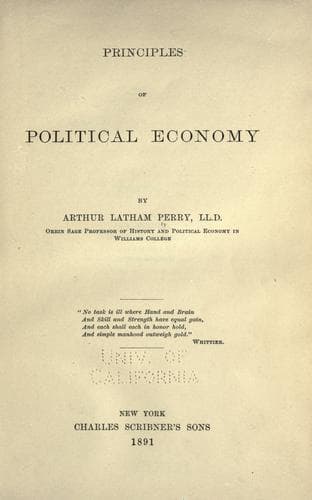
Principles of Political EconomyPerry, Arthur Latham
General
Principles of Political Economy
Perry, Arthur Latham
Economics
the "custody" of their own moneys; and under these general motives on
both sides, there has grown up in all commercial countries an immense
line of Bank Deposits so-called, and perhaps we may say that the
principal function of banks at present is to buy these deposits with
their Credit, and then to handle them in further operations to the
convenience of their customers and to their own gain.
Under our present national banking system the Government is still a
depositor of public moneys in some of the banks designated as
"depositaries." At the close of the fiscal year, 1888, there were 290
of such depositary national banks, and the Treasurer held United
States bonds of the face value of $56,128,000 and the market value of
$68,668,182 in trust for these banks to secure public moneys lodged
with them. This system of national deposit with the banks began in
1864. The total held by the banks June 30, 1888, was $58,712,511, an
increase during the year of $35,395,633.
But our concern is especially with the Bank Deposits of individuals,
with their motives in making these, and with the motives and the
methods of the bankers in handling them. In order to draw the
confidence of the people in its locality, a bank must not only be, but
also _seem_ to be, well-to-do and prosperous. Most bankers find it to
their account to become known owners of public stocks; and in many
cases, as in the present national banks of this country, are required
by law to own such stocks, and this gives them a kind of credit and
public standing scarcely to be reached by the ownership of ordinary
property. Thus the Bank of England held at the outset £1,200,000, and
now holds £15,000,000 of securities, mostly of the public debt of
England. As merchants begin by laying in stocks of goods of the kinds
they purpose to deal in and offering them for sale, so bankers begin
by bringing together money and credits of their own in order to
attract to themselves in the way of buying and selling the money and
credits of other people. In order to deal successfully in credits the
banker must have _credit_, that is, he must have the reputation of
having property of his own, and of being an honest and careful manager
of his own affairs and of the affairs of others so far as they are
intrusted to him. Each of our present national banks, now (1890) 3150
in number, must have by law a paid-up capital of not less than
$100,000, and in cities of 50,000 people their capital must not be
less than $200,000 each, except that in places having less than 6000
inhabitants banks with not less than $50,000 capital _may be_
organized at the discretion of the Secretary of the Treasury. The main
purpose of all this is to secure strong financial organizations fitted
to draw the confidence of the communities in which they are placed,
and in this manner and by means also of constant national supervision
to attract the Deposits of the people to the banks.
Public-domain text, read in full here on John Shaqi.
Reviews
Reviews
No reviews yet
Be the first to share your thoughts on this work.
Elsewhere in the archive
Join the Discussion
Join the discussion
Sign in to leave a comment or review.
Sign InorCreate an account