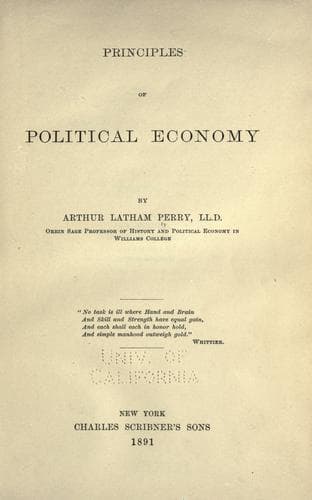
Principles of Political EconomyPerry, Arthur Latham
General
Principles of Political Economy
Perry, Arthur Latham
Economics
Manufacturers and wholesale merchants usually sell their goods _on
time_, as it is called, say three or six months. Debts are thus
created, or to say the same thing in other words, Credits are thus
given. The manufacturer or wholesaler is creditor and the jobber or
retailer is debtor. But a debt is property; and the creditor in this
case wishes to avail himself of his property at once for further
production; so he either takes a Promissory Note from his debtor, or
draws a Bill of Exchange upon him, and this piece of property is ready
for sale. Neither piece mentions _interest_ expressly, but the face
sum virtually covers it as contemplating discount. Banks have been
organized for the express purpose of buying for their own profit and
for the convenience of business such pieces of property; some banker,
accordingly, buys this particular piece, that is to say, this creditor
passes over to this banker the commercial right to demand payment from
this debtor at the end of three months, and receives in return from
the banker either money direct or so much of the banker's credit, that
is, a deposit in favor of the creditor on the banker's books. For
furnishing this creditor either with ready money or a more available
credit in lieu of his mercantile paper, the banker charges of course
_a percentage_. This is _Discount_. _Discount is the difference
between the face and the price of the paper._ This percentage called
discount is the chief source of profit in ordinary banking. It is
virtually compound interest on the sum advanced till the maturity of
the paper, when the banker realizes from the debtor its full face.
The following is a common form of a bankable note:--
$1,000 WILLIAMSTOWN, Mass., Nov. 10, 1889.
Three months after date I promise to pay to the order of
JOSHUA SWAN, one thousand dollars, payable at the
Williamstown National Bank, value received.
Due Feb. 10/13. LEANDER ALLEN.
When Swan has put his name on the back of this note, that is in bank
phrase, has _indorsed_ it, in token that he thereby at once sells and
guarantees it to the bank, it is then discounted on the strength of
the two _names_, Allen and Swan. As Allen technically takes the
advance from the bank for his own benefit, he is technically expected
to take up the note when it matures, and if he do not, the bank falls
back on Swan, who is equally bound with Allen to see that it is paid
at the proper time. Two names are nearly always, not always, requisite
to a note acceptable for discount at a bank; and more names merely
strengthen the note, since it is discounted on the combined validity
of all the names upon it.
Public-domain text, read in full here on John Shaqi.
Reviews
Reviews
No reviews yet
Be the first to share your thoughts on this work.
Elsewhere in the archive
Join the Discussion
Join the discussion
Sign in to leave a comment or review.
Sign InorCreate an account