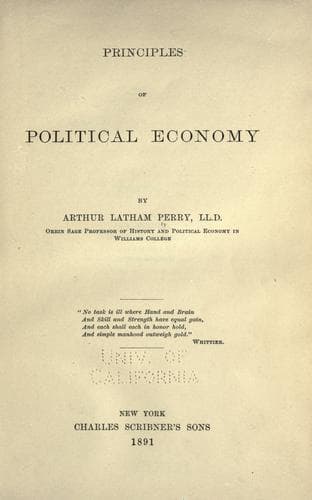
Principles of Political EconomyPerry, Arthur Latham
General
Principles of Political Economy
Perry, Arthur Latham
Economics
Surprisingly large is the amount of bank deposits in all the leading
commercial nations of the world. The average public and private
deposits of the Bank of England, on which no current interest is paid
by the Bank, amounts to about £40,000,000 all the time. The ten
joint-stock banks of London carry about £80,000,000 in private
deposits, of which those to remain some time _draw_ an interest, but
those lodged on current accounts and on call _draw_ none. Scotland has
carried deposit-banking further and to greater advantage than any
other country in the world. There are now no private banks in
Scotland, but the ten joint-stock banks with their numerous branches
scattered to every village in the land hold constantly about
£70,000,000 as individual deposits, on which current interest is
allowed, and so the habit of keeping one's account with a banker has
become universal with the people. No one thinks of keeping money to
any amount in his house or about his person, and consequently
house-breaking and highway robbery have almost ceased. Bankers even
attend all the great fairs in the country to receive deposits and to
pay off cheques. Credit in this form and in another form soon to be
described treads its utmost verge in Scotland. Although in the United
States the custom of keeping deposits with bankers and drawing cheques
against them has not gone nearly so far as in Scotland, and not nearly
so far as it will go in the immediate future, yet the aggregate of
individual deposits in the national banks alone, Oct. 4, 1888, was
$1,350,320,861, an increase in just seven years of 26%.
_e._ Bank Discounts. The credits that are discounted by bankers may be
either the promissory notes of individuals and corporations already
characterized, or the Bills of Exchange soon to be characterized, but
the entire function of discount is so peculiar, that the paper
subjected to it ought to be enumerated in a classification of the
instruments of Credit. The discounting of commercial paper is the
second essential function of banking, as the buying and handling of
deposits is the first; and it is more in accordance with genuine
_banking_ to pass the price of the paper discounted to the seller's
credit in the form of a deposit, that is, to buy one credit by
creating another, than to pay the money over the counter at once, and
thus to buy credits with money. Those who do the latter are called
_bill-discounters_ rather than bankers, but most of our bankers do
both, though there is a tendency towards the separation of the two in
this country also.
Public-domain text, read in full here on John Shaqi.
Reviews
Reviews
No reviews yet
Be the first to share your thoughts on this work.
Elsewhere in the archive
Join the Discussion
Join the discussion
Sign in to leave a comment or review.
Sign InorCreate an account