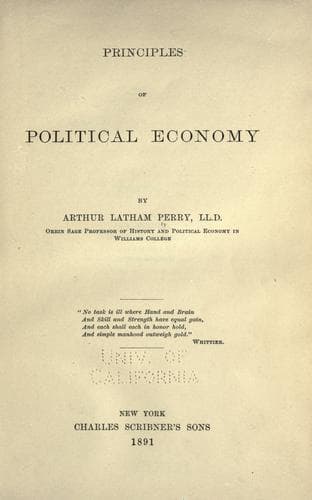
Principles of Political EconomyPerry, Arthur Latham
General
Principles of Political Economy
Perry, Arthur Latham
Economics
Very similar to these inland bills in their nature and course and
usefulness are Foreign Bills of Exchange, which, as a vastly important
topic, especially in its relations with Foreign Trade, we must now
study minutely and completely. Commercial relations between two
countries, let us say, for instance, France and England, always give
rise to a mutual indebtedness of their merchants; if these reciprocal
debts were all to be paid by the actual sending of money to and from,
there would have to be a constant and expensive and more or less
hazardous outward and inward flow of the precious metals in respect to
each country; all which necessity is neatly obviated by the use of
reciprocal bills of exchange, and coin is only transmitted to settle
the balances on whichever side there may happen an excess of debt at
the time. French dealers are always sending goods to England, and
English dealers goods to France; and for what they send to England the
French merchants draw bills of exchange on the parties to whom the
goods are consigned, and the English merchants draw similar bills on
their debtors in France; then these bills are bought up by bankers or
brokers in either country, and virtually exposed again for sale
through new bills drawn against them to any parties who may have debts
to pay in the other country. Thus bills on London, in other words, on
English debtors, are always for sale in France; and bills on France,
that is, on French debtors, are always for sale in London; the
reciprocal debtors of the two countries, therefore, instead of sending
coin to cancel their debts, buy and transmit these bills.
Let us take a sample instance. Pierre & Co. of Paris send a cargo of
wine worth £1000 in English money to John Barclay of London. Barclay
thus becomes indebted to the Paris firm to that amount, and Pierre &
Co. draw at once, so soon as the cargo is despatched, a bill in francs
to the equivalent of £1000. If they themselves have no debt to pay in
London, they will sell this bill immediately to a Paris banker or
broker (if the exchange be then at par) for its full face _minus_
interest for the time it has to run, say two months; this broker is
now ready to sell this bill again, or what is the same, his own bill
drawn on the strength of it, to anybody in Paris who may have a debt
to pay in London; and the party in London who receives it in
liquidation of a French debt to him, presents it at maturity to John
Barclay for payment. Thus one bill of exchange serves the ends of two
creditors and one debtor: Pierre & Co. get their pay for the wine, the
London party gets his pay for goods, and Barclay pays his debt, by
means of it. A bill drawn in London for a cargo of hardware sent to
Paris is similarly negotiated with a London broker or banker, and
finds its way similarly to France in payment of some English debt owed
there, and ends its course when it reaches the French firm on which it
was originally drawn.
Public-domain text, read in full here on John Shaqi.
Reviews
Reviews
No reviews yet
Be the first to share your thoughts on this work.
Elsewhere in the archive
Join the Discussion
Join the discussion
Sign in to leave a comment or review.
Sign InorCreate an account