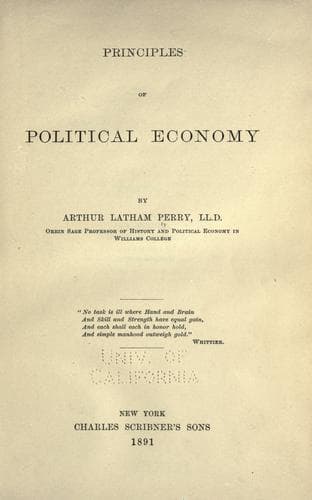
Principles of Political EconomyPerry, Arthur Latham
General
Principles of Political Economy
Perry, Arthur Latham
Economics
We are now in position to understand clearly what is meant by the _par
of Exchange_ in its commercial (not coinage) import. The merchants in
Paris, who have debts due to them from London, draw bills of exchange
for the amount of these debts; and, through the agency of middlemen,
go into the market to sell these bills to other Paris dealers who have
debts to pay in London. If the former class have a larger amount to
sell than the latter have occasion to buy, in other words, if there be
a larger amount of debts due from London to Paris than from Paris to
London, then the natural competition of the sellers in Paris of the
bills on London will lower their price somewhat in that market
(Paris), in order, as usual, that the Supply and Demand may be
equalized there. In this case the par of exchange is disturbed, a bill
on London for £100 in francs may not sell for over £99, and the
exchange is then said to be 1% _against_ London, or, which is the same
thing, 1% _in favor_ of Paris.
The _par of Exchange_, accordingly, between two countries, depends on
the substantial equality of their commercial debts. In the above
example, if the exchange as against London in favor of Paris continue
long, and especially if the premium of 1% on bills drawn in London on
Paris be sufficient to cover the expense of the transmission of specie
from London to Paris, gold will begin to flow from London to Paris,
because the debtors there may find it cheaper for themselves to buy
and send gold than to pay the high premium on bills; and thus the
equilibrium of payments and the commercial par may be restored. Also,
this par tends to restore itself, without any sending of specie, in
this other perfectly natural and effectual way: if bills on Paris are
at a premium in London, for the same reason that they are so will
bills on London be at a discount in Paris; therefore, there will be a
direct encouragement to the extent of the premium for _exportation_ of
goods from England to France, because on every cargo thus sent bills
can be drawn and sold in London for a premium; while the more bills on
Paris thus offered in London, the more the premium disappears of
course, and the par will be restored so soon as the bills on Paris
substantially equal the bills on London offered in Paris; and at the
same time, so long as the discount on London bills continues in Paris,
there is a direct _discouragement_ to further exportations from France
to England, because the bills drawn in virtue of such cargoes can
only be sold below par, and this too tends to _restore_ the par in the
commercial sense of the term.
Public-domain text, read in full here on John Shaqi.
Reviews
Reviews
No reviews yet
Be the first to share your thoughts on this work.
Elsewhere in the archive
Join the Discussion
Join the discussion
Sign in to leave a comment or review.
Sign InorCreate an account