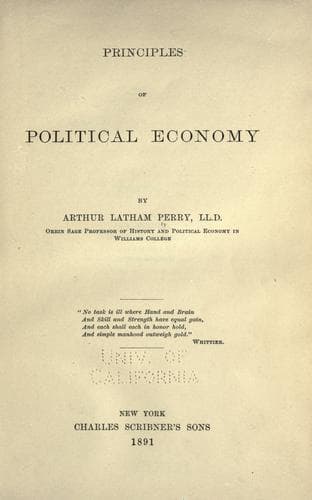
Principles of Political EconomyPerry, Arthur Latham
General
Principles of Political Economy
Perry, Arthur Latham
Economics
Here is another instance of a magnificently comprehensive law, by
which Nature vindicates her right to reign in the domain of Exchange.
It is through this natural and beneficent law of automatic
compensations, stimulating exportations on the one side and slackening
them on the other, that most of the casual disturbances of the
commercial par as between two countries are easily and perfectly
rectified.
While this great law is in full possession of our minds, let us note
in passing how artificial restrictions by one country on the
importation of goods from another, commonly called "Protectionism,"
affects this commercial par as between those two countries. Besides
stopping absolutely a mass of otherwise profitable exportations and
importations for both countries, it makes less profitable to the
country imposing the restrictions whatever foreign trade _does take
place_ between them in spite of the restrictions. Suppose England, as
is the fact, opens her ports freely to the commodities of France,
while France puts restrictions in the shape of heavy taxes upon
importations from England; more French goods are likely under these
circumstances to seek English ports than English goods to seek French
ports, because they are more welcome; consequently, more bills of
exchange drawn on London will naturally be offered in Paris than bills
on Paris in London, and will so far forth be sold at a discount, while
the London bills drawn on Paris will be sold at a premium; in other
words, the comparatively few goods that do get out of a "protected"
country, realize less to their owners than the natural value, because
the bills drawn on them are extremely apt to be sold below par! With
this course of things all known facts agree. Since the United States
became conspicuously a "protected" country a quarter of a century ago,
it has been at rare intervals and for short periods that bills drawn
here on London have been at par. They have been usually much below
par. The equivalent of £1 sterling in United States money is $4.8665;
and when bills on London sell for less per pound sterling than $4.86,
they are at a discount in New York or Boston; and exporters here are
direct losers to the extent of the discount.
Public-domain text, read in full here on John Shaqi.
Reviews
Reviews
No reviews yet
Be the first to share your thoughts on this work.
Elsewhere in the archive
Join the Discussion
Join the discussion
Sign in to leave a comment or review.
Sign InorCreate an account