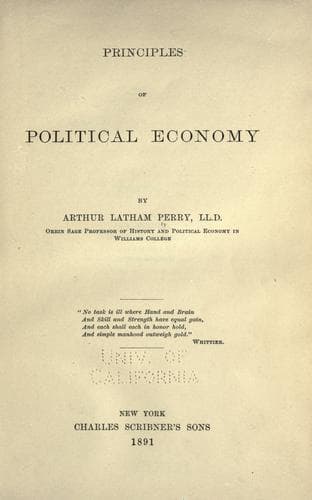
Principles of Political EconomyPerry, Arthur Latham
General
Principles of Political Economy
Perry, Arthur Latham
Economics
Very little, if anything, can be inferred as to the prosperity of a
country or even as to the real condition of its "exchanges" in this
technical sense of the term, by the transient movements of gold to and
from the commercial countries, in their present complex relations as
gold-producing and non-gold-producing countries and as debt-settling
and non-debt-settling centres. Gold moves back and forth in obedience
to several other impulses than to settle the balances in an
international trade of Commodities. Gold-producing countries of course
export gold just as they would any other native product. If for any
reason gold becomes relatively more abundant in one country than in
other commercial countries around it, general prices will rise in that
country in consequence; which means, that gold is then and there the
cheapest article that the people of that country can export to pay
their commercial debts with. Also, the imports which a nation pays for
in gold, or in bills of exchange bought above par, are often bought
with a high profit. Creditor nations, nations that have managed to
make themselves settling-places for the world's commercial debts, and
nations that welcome imports without impediment from every quarter of
the earth (and England may serve as a sample for all these three),
will largely pay for imports in gold or in bills bearing a premium.
It is a thousand pities, that technical terms which are quite
misleading unless one remembers their origin and exact significance,
have come to be intrenched in commercial language too strongly to be
dislodged at this late day, as the common terms to express the state
of the "exchanges" as between two countries. These terms are
"_against_" and "_in favor of_." The old Mercantile system, which has
left other unsavory progeny behind it besides this, in order to keep
and heap gold and silver in a country, encouraged exports in every way
and discouraged imports, in order that the "_balance of trade_," as
the phrase ran, that is, the difference in volume between exports and
imports, might come back to the country in gold and silver; and this
foolish and now thoroughly exploded notion gave rise to the terms in
question; exchanges were then said to be "against" a country when the
record seemed to show more imports than exports, as if that implied
that the imports were too great for a "balance" in gold and silver;
and were said to be "in favor of" a country when its export-line was
greater than the line of imports, as implying a favorable balance to
be met by a specie-import in future. The false "System" is gone
forever, but the "terms" still abide in commercial language, and
confuse the minds more or less (more rather than less) of everybody
who tries to make these terms a vehicle of thought. We have now
described the causes and courses of international bills of exchange
without resorting to these technicalities, which imply movements of
gold and silver which do not actually take place under the conditions
Public-domain text, read in full here on John Shaqi.
Reviews
Reviews
No reviews yet
Be the first to share your thoughts on this work.
Elsewhere in the archive
Join the Discussion
Join the discussion
Sign in to leave a comment or review.
Sign InorCreate an account