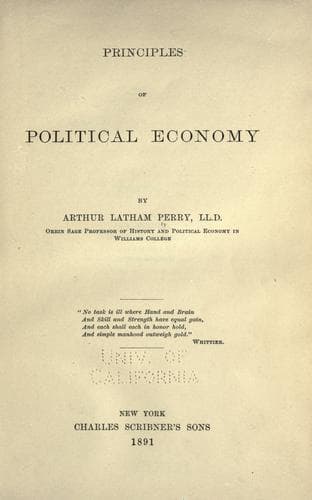
Principles of Political EconomyPerry, Arthur Latham
General
Principles of Political Economy
Perry, Arthur Latham
Economics
supposed; for example, the exchanges were "in favor" of the United
States in 1874-77, there being an apparent trade balance of
$164,000,000 in 1877 and a still larger in 1876 and a larger one in
the two years preceding, but the import of specie was small in all
those years, averaging about $25,000,000 a year, and the rest of the
excess of exports went to pay interest due to foreigners, freights on
the cargoes both ways, and so on. It is difficult to use without
abusing the terms "against" and "in favor of" in this connection, and
the reader is cautioned not to employ them; although "discount" and
"premium" on international bills of exchange are matters extremely
important to observe and to know the grounds of. Were there no
counterworking principle, bills of exchange drawn _on_ capitalist and
creditor countries, like Great Britain, whose imports are apt to be
strongly in excess of the exports, and whose public policy is wise
enough to put no obstacles in the way of the free receipt of imports,
would be at a _discount_ in countries sending exports thither.
This counterworking principle, already illustrated as to inland
exchange in the case of New York, is best seen internationally in
connection with London, which is the settling-place of the world's
commerce. When the Romans dredged the Thames and made "the pool" just
below London Bridge, they took the first steps towards making that
town a commercial centre; since a market for products is products in
market, the busy exchange of commodities there has quickened in every
age the accumulation of capital and the increase of population;
previous to the Dock Laborers' Strike in 1889, about 100 vessels
entered the port of London every day, which received about one-half of
the total customs revenue of the United Kingdom, and sent out about
one-fourth of its exports; the business of out-of-the-way and
semi-civilized countries has somehow (and it would not be hard to tell
why) centered in London, as well as the business of originally British
Colonies everywhere and of all other commercial countries;
accordingly, debtors and creditors abound there, bills of exchange
concentre there, and debts due from everywhere are payable _there_;
and therefore, because bills on London are good all over the world,
the Demand for them counterworks the natural cheapness of the bills
drawn on exports _thither_ as compared with the natural dearness of
the bills drawn there on exports _thence_.
Public-domain text, read in full here on John Shaqi.
Reviews
Reviews
No reviews yet
Be the first to share your thoughts on this work.
Elsewhere in the archive
Join the Discussion
Join the discussion
Sign in to leave a comment or review.
Sign InorCreate an account