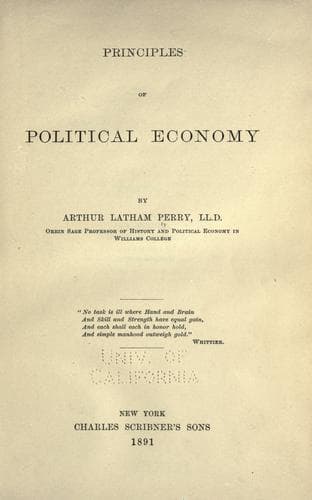
Principles of Political EconomyPerry, Arthur Latham
General
Principles of Political Economy
Perry, Arthur Latham
Economics
Another thing must be borne in mind in comparing the merchandise
accounts of any country, namely, that whenever the "exchange" is
sufficient to cover the cost and risk of the transmission of gold,
gold itself is likely to go freely from the country, in which bills
drawn on exports are at a premium, or to use for once the old
hazardous phrase, "_against_" which the exchanges have turned, and
bills will be drawn on that gold, as upon common merchandise, and sold
of course for the sake of the premium; or, if a decidedly higher rate
of discount prevail in a neighboring country, gold will naturally go
thither from the lower-rate lands, because lenders in the latter will
desire to realize the higher rate of current interest on money, and
bills will be drawn on this gold as well, which will tend to lower the
premium on bills there; unless, then, the premium _and_ the difference
in interest abroad will justify the speculation, the gold will not
stir; although, if the difference in interest abroad were very
considerable and promised to continue for some time, the bills on the
gold might sell at a discount and still leave a profit to the senders;
but the home bankers can always stop a drain of gold of this kind by
raising their own rates of discount.
This casual mention of bankers leads on to the weighty point, that the
whole business of foreign exchange is falling more and more into the
hands of the bankers, because bills drawn _by_ and _upon_ well-known
bankers naturally have a better credit than ordinary commercial bills,
the names upon which are less widely and favorably known. Accordingly,
persons sending cargoes of cotton, say, or of any other valuables,
from New York to Liverpool, arrange with their bankers in New York to
have the proceeds of the cargoes put to the _bankers'_ credit in
London, and then these bankers draw bills on the London bankers, which
will bring a higher price in New York than a common commercial bill,
because many remitters and most travellers prefer bankers' bills,
which, though they cost more, pay better and buy better abroad.
Commercial bills are still bought and sold in every commercial town,
but bankers' bills are more and more taking their place; and the
quotations usually give the current price of each.
Public-domain text, read in full here on John Shaqi.
Reviews
Reviews
No reviews yet
Be the first to share your thoughts on this work.
Elsewhere in the archive
Join the Discussion
Join the discussion
Sign in to leave a comment or review.
Sign InorCreate an account