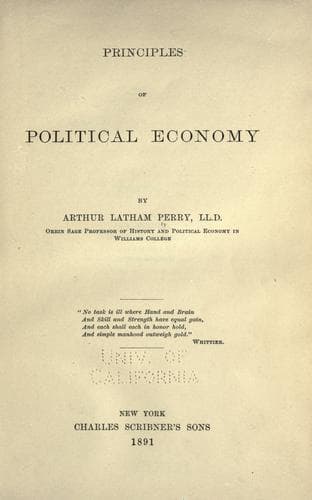
Principles of Political EconomyPerry, Arthur Latham
General
Principles of Political Economy
Perry, Arthur Latham
Economics
All the clerks report to the manager the amounts _received_ by each,
and as his proof-sheets hold already the amounts _brought_, if the two
columns add up alike, no mistake has been made, and the general
clearing is over. Thirty-five minutes are allowed the clerks to enter,
report, and prove their work. Fines are imposed for errors discovered
after that time. The Clearing-house gives tickets of debit or credit
to all the banks, and the debit ones must pay in lawful money before
half-past one, and the credit ones will get their due from the manager
immediately after. The largest sum ever cleared in New York in one day
was $206,034,920.51 on Nov. 17, 1868, and the smallest $8,357,394.82
on Oct. 30 of the panic year, 1857.
_h._ Crossed Cheques. About twenty years ago there was instituted in
London what is called the Cheque-Bank, which is designed to bring the
benefits of the credit-system in the form of cheques more easily to
all classes of the people. The cheques issued by this institution are
so different in character and in course from common bank-cheques, and
are in some respects so new in principle, that we must give to them a
separate heading and a full explanation.
The Cheque-Bank is a stock company in London under that style, which
has entered into relations with nearly all the banks and bankers of
the United Kingdom, and with many Colonial and foreign banks also, by
which Cheque-Books are furnished for sale by the Cheque-Bank through
these associated banks, which also agree to cash the cheques, every
cheque in which books indicates by printed and indelible perforated
notices upon the forms what the utmost sum is against which that
cheque can be drawn; the aggregate of these perforated sums is the
price for which each book is sold less 1-1/5 penny for each cheque in
it, of which the penny is for the Government stamp required and the
one-fifth for the profits of the Cheque-Bank; and all these cheques in
books of different sizes and amounts are drawn in form _on_ the
Cheque-Bank, and _Crossed_, that is, _only made payable through a
banker_. It is one security against fraud that each cheque bears on
its face the utmost sum for which it can be used, and another is that
it can only be taken up by a banker and thus settled ultimately
through the clearing-house. The Crossed Cheques Act of Parliament in
1876 makes any obliteration of the crossing or essential alteration of
a cheque _felony_ at law.
Public-domain text, read in full here on John Shaqi.
Reviews
Reviews
No reviews yet
Be the first to share your thoughts on this work.
Elsewhere in the archive
Join the Discussion
Join the discussion
Sign in to leave a comment or review.
Sign InorCreate an account