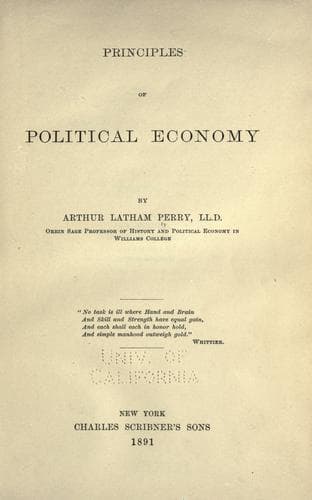
Principles of Political EconomyPerry, Arthur Latham
General
Principles of Political Economy
Perry, Arthur Latham
Economics
Since these cheques are crossed _generally_ (not specially) with the
words "and Co.," that is to say, since they can ultimately be taken up
only by some banker, they have a more _generalized_ character than
common bank-cheques, they are safer to carry and keep than so much
money would be, there is no difficulty in shopping or paying wages by
means of them, they are very much the same in their nature as bank
bills are, and might easily in certain circumstances become _money_
just as bank bills in some circumstances are money. Each of the
associated banks keeps an account of course with the Cheque-Bank, but
is not obliged to keep a separate account with the purchasers of
cheque-books, which is a great relief to the banks. In this way the
Cheque-Bank extends the use of cheques in the lieu of money to a great
multitude of small transactions, and relieves the other banks from
what would otherwise be a great deal of troublesome accounting and
collection. The ingenuity and the utility of this comparatively new
form of Credit cannot be questioned for one moment; the promoters of
the Bank intended that their cheques should be received by the people
as a substitute for cash and for Post Office orders, and such has been
the effect, many railway and other companies having long ago agreed to
receive them as cash, and the people generally regard them as cheaper
and more convenient than postal orders and even for many purposes than
cash.
_i._ Cash Credits. As the Cheque-Bank in the sense as just explained
has been thus far in the history of Credit peculiar to England, so we
have now to look to Scotland only for an exemplification of a form of
Credit hitherto confined to that country. It is a national
characteristic of the Scotch to be "canny," that is, they _can_, a
word from the old Teutonic _können, to be able_; and, as a
consequence, Scotch Banking has long been famous the world over; and
the one peculiarity of it, with which we are now concerned, goes back
certainly to 1729, as we happen to know from a minute of the Directors
of the Bank of Scotland under that date. That bank was chartered by
the old Scotch Parliament in 1695, one year after the chartering by
the English Parliament of the Bank of England, and under substantially
the same title as that, namely, "The Governor and Company of the Bank
of Scotland." It began to establish branches in different towns of the
realm in 1696, and began to issue bank notes for £1 (a privilege
denied to the Bank of England) in 1704; and it began also at a very
early period to exhibit the two main peculiarities of Scotch banking,
namely, (1) to receive deposits _on interest_ and (2) _to grant credit
on cash accounts_, or, as they have come to be called less properly,
Cash Credits.
Public-domain text, read in full here on John Shaqi.
Reviews
Reviews
No reviews yet
Be the first to share your thoughts on this work.
Elsewhere in the archive
Join the Discussion
Join the discussion
Sign in to leave a comment or review.
Sign InorCreate an account