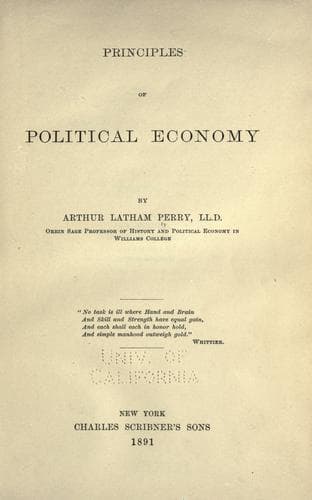
Principles of Political EconomyPerry, Arthur Latham
General
Principles of Political Economy
Perry, Arthur Latham
Economics
This second peculiarity, which has proved extremely beneficial to
Scotland, is for substance this, to create a drawing account in favor
of a deserving customer, who has made as yet no deposits in the bank,
but who draws out money and pays it in from time to time just like an
ordinary depositor, and instead of receiving interest on the daily
balance to his _credit_ (old Scotch fashion), he pays interest on the
daily balance to his _debit_. These accounts are called Cash Credits.
They are not intended to be dead loans, but quick accounts; and they
are not granted except to persons in business, or to those who are
frequently drawing out and paying in money. The individual who has
obtained such a credit is enabled to draw the whole sum, or any part
of it, when he pleases, replacing it, or portions of it, when he
pleases, according as he finds it convenient, interest being charged
only upon such part as he draws out.
David Hume in his Essay of the Balance of Trade, published in 1752,
makes this nice point in favor of Cash Credits: "If a man borrows
£5000 from a private hand, besides that it is not always to be found
when required, he pays interest for it whether he be using it or not.
On the other hand, his Cash Credit costs him nothing, except during
the moment it is of service to him; and this circumstance is of equal
advantage as if he had borrowed money at a much lower rate of
interest." The Cash Credit is always for a limited sum, seldom under
£100, given upon the customer's own security, and that in addition of
two or three individuals approved by the bank, who become sureties for
its payment. Of course, only those banks can furnish such credits
which possess a surplus of credit more than they can sell in the
ordinary way, and these credits are safe and useful only in small
communities, in which men are well known to each other. Some friends
of the parties thus accommodated always guarantee the bank against
loss; but the losses have proved to be insignificant, the gains to be
marvellous; and this form of credit issued on the basis of no previous
transaction in the way of deposits illustrates better than any other
the radical principle, that Credit is Capital.
Public-domain text, read in full here on John Shaqi.
Reviews
Reviews
No reviews yet
Be the first to share your thoughts on this work.
Elsewhere in the archive
Join the Discussion
Join the discussion
Sign in to leave a comment or review.
Sign InorCreate an account