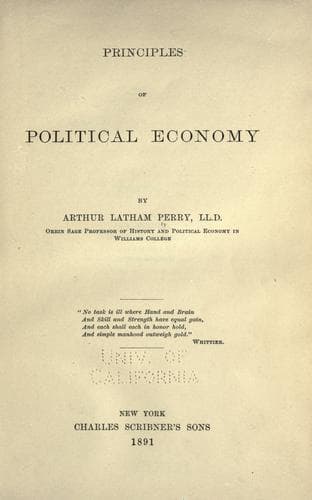
Principles of Political EconomyPerry, Arthur Latham
General
Principles of Political Economy
Perry, Arthur Latham
Economics
_j._ Circular Credits. These are a device of bankers to enable
travellers and merchants of one country to obtain credit and cash in
foreign countries in sums to suit their convenience, not to exceed in
the aggregate the limit mentioned in the credits drawn. These credits
assume different forms and are called by different names, but they are
all at bottom foreign Bills of Exchange. They are Orders to pay. They
are drawn by Bankers at home upon Bankers abroad. They are bought by
travellers and others, because they are safer to carry than so much
money would be, and much more convenient. In nearly all of those forms
the credits are available for no one else than the payee, whose name
is upon the form as well as the names of the bankers who are the
drawees, and so the credits are not liable to be stolen, although they
may be temporarily (not ultimately) lost. Purchasers of such credits
can obtain money on them in all of the principal cities of the world
in just such sums as they need. They have ultimately to pay for no
more credit than they actually use, because the drawer will pay back
to the payee, in case he has bought and paid for the entire credit
drawn, the cash difference; while on the other hand, arrangements can
always be made beforehand, by which money need not be deposited with
the banker at home any faster than it is actually called for abroad;
and while also a good customer of the bank drawing the credit, one who
keeps ordinarily a good line of deposits, may pay for whatever credit
he has used when he returns from his trip.
Public-domain text, read in full here on John Shaqi.
Reviews
Reviews
No reviews yet
Be the first to share your thoughts on this work.
Elsewhere in the archive
Join the Discussion
Join the discussion
Sign in to leave a comment or review.
Sign InorCreate an account