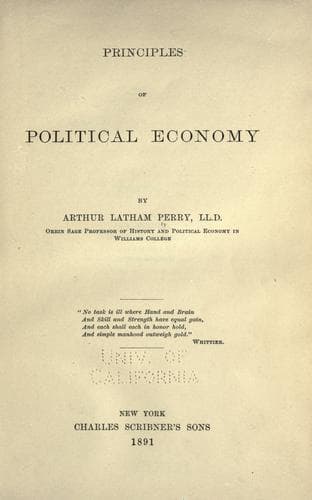
Principles of Political EconomyPerry, Arthur Latham
General
Principles of Political Economy
Perry, Arthur Latham
Economics
Lastly, (f) _There were two satisfactions_, the satisfaction of the
southern king in actually obtaining the excellent timbers, without
which the cherished national temple could not have gone up; and the
satisfaction by the northern king in the easy receiving of the
abundant food products for the daily maintenance of his court and
kingdom. The simple story of these commercial transactions between Jew
and Tyrian indicates clearly enough, what might have been anticipated
and what always happens in such circumstances, not only a mutual
satisfaction at the completion of each specific exchange, but also a
general relation of contentment and peace in consequence of
advantageous commercial intercourse. "_And Hiram, king of Tyre, sent
his servants unto Solomon; for he had heard, that they had anointed
him king in the room of his father; because Hiram was ever a lover of
David. And it came to pass, when Hiram heard the words of Solomon,
that he rejoiced greatly, and said, Blessed be the Lord this day,
which hath given unto David a wise son over this great people; and
there was peace between Hiram and Solomon; and they two made a league
together._"
It is plain to reason and to all experience, that mutual Satisfactions
are the ultimate thing in exchanges. Our present analysis can go no
further, for the reason, that we have now reached in Satisfactions the
end, for the sake of which all the previous processes have been gone
through with. Persons do not engage in buying and selling for the mere
pleasure of it, but always for the sake of some satisfactions
derivable to both parties from the issue of it. Ordinary
self-inspection and foresight and industry being presupposed, the
issue of exchanges is just what was expected by the two persons, the
satisfaction of each follows as a matter of course, and stimulates to
new exchanges in ever-widening circles.
Since the desires of all men, which the efforts of other men can
satisfy through exchange, are indefinite in number and unlimited in
degree, there is no end of human Satisfactions to be reached along
this road of reciprocal trade; and since the very object of all trade
and the actual result of all trade (the exceptions are infinitesimal)
is to multiply and reduplicate continually mutual Satisfactions among
men; we can see right here what a loss and wrong it is, what a wanton
destruction of possible human happiness it is, what a bar to progress
among men in comforts and powers it is, for nations to impede and to
prohibit commerce by legislation! As we shall see more fully in a
later chapter, Governments can have no moral or constitutional right
to restrict the trade of their people, except in the sole interest of
revenue or health or morals.
Public-domain text, read in full here on John Shaqi.
Reviews
Reviews
No reviews yet
Be the first to share your thoughts on this work.
Join the Discussion
Join the discussion
Sign in to leave a comment or review.
Sign InorCreate an account