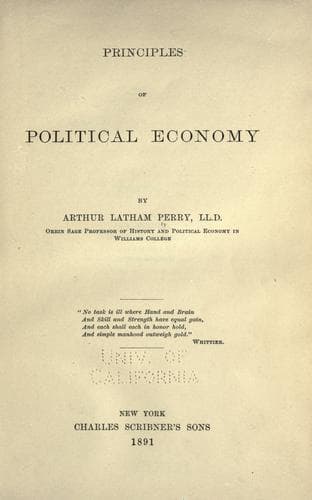
Principles of Political EconomyPerry, Arthur Latham
General
Principles of Political Economy
Perry, Arthur Latham
Economics
(1) There are young men in every advanced community in the world who
have integrity and industry and skill, but little or no _Capital_; and
when such men are enabled to borrow money, as by the Scotch system of
"cash accounts" or otherwise, to start themselves in business or to
enlarge a business already in successful operation, the general
interests of Production as well as their own personal interests, are
greatly subserved by such credit; because in all probability much
capital thus passes out of hands which are _less_ into hands which are
_more_ able to use it _productively_. Those who are best able to make
capital _tell_ by increase are generally those who are most desirous
to obtain it, and frequently those who can offer the best security for
its replacement. Nothing, therefore, is to be said against, but
everything in favor of, such a loaning of capital as shall bring it
under safe conditions from the hands of the idle and the aged, from
those indisposed or incompetent to use it productively, into other
hands at once competent and honest. Such credits as these are a
benefit and only a benefit to all the parties concerned, and to
Society at large. The active operators retain something of profit
after replacing the capital with current interest upon it; the lenders
receive more than if their capital remained idle, or they employed it
themselves; and Society is benefited by a more complete development,
and rapid circulation, of Services. Despite all the instances of
broken faith, it is still an honor to human nature, that men do so
gain by good character the confidence of their fellows, that they are
and ought to be trusted with capital on their simple word or note; and
it is the glory of free political institutions, that under their
influence more than elsewhere, young men do rise by the help of so
slight a stepping-stone as this, in crowds, to the high places of
opulence.
In the important point of view, that thus all of the available capital
of a community is brought out into productive activity, too much can
scarcely be said of Savings-Banks, which take the surplus earnings of
the poor, and not only keep them safely, but pay a fair interest on
each deposit, and loan the aggregate at a higher rate on choice
securities, thus stimulating frugality in a wide circle of depositors,
and at the same time aiding Production by opportune loans to the best
class of borrowers. In the year 1881, there were $443,000,000 invested
in savings-banks in the State of New York, and $230,000,000 in the
small State of Massachusetts.
Public-domain text, read in full here on John Shaqi.
Reviews
Reviews
No reviews yet
Be the first to share your thoughts on this work.
Elsewhere in the archive
Join the Discussion
Join the discussion
Sign in to leave a comment or review.
Sign InorCreate an account