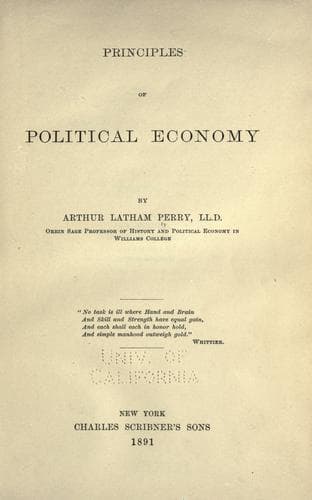
Principles of Political EconomyPerry, Arthur Latham
General
Principles of Political Economy
Perry, Arthur Latham
Economics
In the Metropolitan Museum of Art in New York are Babylonian tablets
bearing distinct records of credit transactions that took place in the
reign of Nebuchadnezzar. The earliest tablet is of the year 601 B.C.
On it are memoranda of loans of silver made by Kurdurru as follows: "1
mina of silver to Suta, 1 mina to Balludh, 1/2 mina to Buluepus, 5
shekels to Nabu-basa-napsate, and 5 shekels to Nergal-dann;--total, 3
minas, 5 shekels of silver." There are more than 50 similar tablets in
this collection; the latest dated, "Babylon, 18th day of 14th year of
Darius," that is, B.C. 505. M. Lenormant, who can read them, divides
these credit documents into five principal types. 1. Simple
obligations; 2. Obligations with a penal clause in case of
non-fulfilment; 3. Obligations with the guarantee to a third party; 4.
Obligations payable to a third person; and 5. Drafts drawn upon one
place, payable in another. These last are letters of Credit. They
contain the names of several witnesses. They are evidently negotiable,
but from the nature of things could not pass by indorsement, because
when the clay was once baked nothing new could be added, and under
these circumstances the name of the payee was often omitted. It seems
to follow from this peculiarity, that the drawee must have been
regularly advised by the drawer. One of the credits in this most
interesting collection had 79 days to run.
The main elements of their civilization came to the Greeks, and
especially to the Greek cities in Asia Minor demonstrably from the
Eastward; the Greek West proved itself quick to catch up the thoughts
and the modes of the East; accordingly, Isocrates in his plea against
the banker, Pasion, describes a formal bill of Exchange bought by
Stratocles in Athens, payable in Pontus, and guaranteed principal and
interest by Pasion; the practical Romans were pupils of the Greeks in
all such matters, and so it came about in course of time, that Cicero
wrote as follows in a letter to Atticus,--"Let me know, if the money
my son needs at Athens can be sent him _by way of exchange_, or if it
be necessary for it to be taken to him,--_permutarine possit an ipsi
ferendum sit_"; and after that the Jews and the Lombards carried the
Letter of Credit all over the world.
It goes without saying, when the most civilized and advanced people of
the world were the first to adopt and have been since the quickest to
expand the use of Credit, that there must be pretty obvious and very
solid advantages from such use and expansion; and we must now note and
weigh a few of these advantages.
Public-domain text, read in full here on John Shaqi.
Reviews
Reviews
No reviews yet
Be the first to share your thoughts on this work.
Elsewhere in the archive
Join the Discussion
Join the discussion
Sign in to leave a comment or review.
Sign InorCreate an account