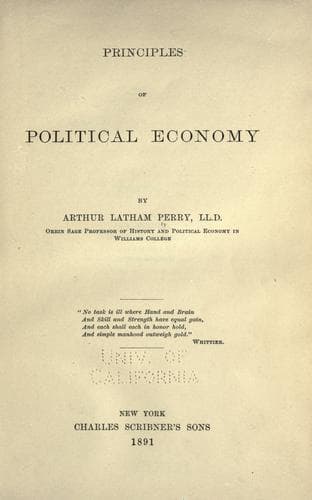
Principles of Political EconomyPerry, Arthur Latham
General
Principles of Political Economy
Perry, Arthur Latham
Economics
(2) There is another class of advantages in Credit, which do not
depend so much on the transfer of Capital from less to more productive
hands, as on the facilities which credit affords in economizing the
general operations of Exchange. Here the advantages are derived from
the convenience of _settling accounts_ arising out of exchanges,
rather than from the _character_ of the exchanges themselves. Look a
moment, for example, at foreign Bills of Exchange. They serve to
settle up the accounts arising from the Commerce of two or six
Continents, with but little transmission of money from any, and with
but very little loss of time. Commercial bills drawn in New York on
London have been usually payable at sixty days' sight; the New York
merchant despatching a ship is able to realize at once the value of
her cargo, minus interest for the time his bill has to run; since
bankers' bills have so largely taken the place of "commercial" bills,
the time is much shortened thereby, and this is one reason why
bankers' bills bear a higher price in the market; the merchant or
sender is indeed still liable in part to see that his bill is
ultimately paid by the drawee; but the commercial integrity of the
leading houses and leading banks in all countries is with justice so
firmly believed in and acted on, that on the whole but little anxiety
springs from this source. It is one of the noble things in
international commerce, that men trust each other across the oceans,
and lay millions of value on the faith of a single firm.
Inland bills of exchange equally facilitate settlements within the
country itself; and cheques, which are of the same essential nature as
inland bills, contribute to the same end even more simply and surely,
passing readily in payments wherever the parties are known, and
through credit and set-off doing the work of money more conveniently
and economically than, and within certain limits just as safely as,
money itself could do it. The face of a cheque drawn to the amount of
his deposit in favor of another depositor in the same bank is
transferred in the banker's books from the credit of the drawer to
that of the payee by the stroke of a pen, no money at all passes in
the premises, while the banker is released from one debt by creating
another of equal amount, the drawer is released from one debt by
another to be transferred to the payee, and the payee is paid by the
drawer by the former's receipt of another debt more acceptable to him.
Public-domain text, read in full here on John Shaqi.
Reviews
Reviews
No reviews yet
Be the first to share your thoughts on this work.
Elsewhere in the archive
Join the Discussion
Join the discussion
Sign in to leave a comment or review.
Sign InorCreate an account