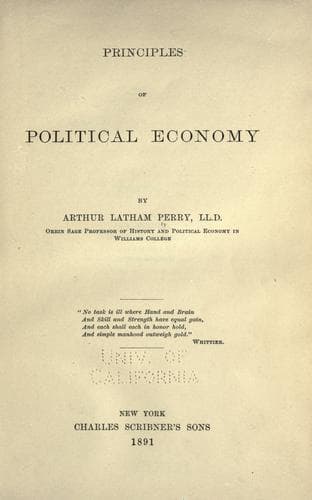
Principles of Political EconomyPerry, Arthur Latham
General
Principles of Political Economy
Perry, Arthur Latham
Economics
(3) Besides the two essential functions of all banks, namely, the
receiving of deposits and the discounting of bills, most of them
perform a variety of other legitimate operations in Credit, which must
be classed among the advantages of Credit. They buy and sell debts of
all sorts. They make collection of debts for their customers. They
sell their own drafts on distant places. Since 1863, our national
banks have done an immense business in handling the debt of the United
States: they were instrumental in diffusing the national bonds among
all classes of the people: they collect for their customers the
coupons at maturity: they have been and still are the factors of the
government in exchanging, for those who desire it, one species of bond
for another; and the entire debt of the United States has been several
times changed, mainly through the agency of the banks, from bonds at
high rates of interest and for short times of maturity to bonds at
lower rates and for longer times.
(4) The fourth, and probably the chief, advantage of Credit is the
fact, that a new purchasing-power is created by means of it, a new
Valuable, something additional to all existing before in the world of
Values. One can buy other things with Credit, as well as with material
Commodities and personal Services. Credit, therefore, becomes a
Salable under the two peculiar limitations already explained, those of
future Time and personal Confidence, just as Commodities become a
Salable under the peculiar limitations belonging to _them_; and, what
is more to the present purpose, just as some Commodities (all of them
salable) become Capital under the action of the abstinence of their
owners, so some Credits (all of them salable) become Capital under the
action of the Abstinence of their owners. Some commodities and some
credits are expended, that is, sold, for the immediate gratification
of their owners, without ever a thought of a future increase to
accrue; but also, some commodities and credits are reserved by their
owners for use in further production, that is, for future buying and
selling; and the motive in all such cases is the same that creates all
Capital everywhere, namely, the increase to accrue as the result of
such abstinence; and, consequently, we lay down the postulate with all
confidence, and enumerate it as one of the main advantages of Credit,
that some Credits are CAPITAL, with all the powers in production of
that potent agent already exemplified.
Public-domain text, read in full here on John Shaqi.
Reviews
Reviews
No reviews yet
Be the first to share your thoughts on this work.
Elsewhere in the archive
Join the Discussion
Join the discussion
Sign in to leave a comment or review.
Sign InorCreate an account