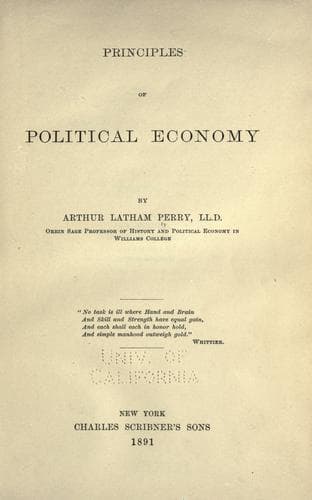
Principles of Political EconomyPerry, Arthur Latham
General
Principles of Political Economy
Perry, Arthur Latham
Economics
distinction, by requiring the banks to loan money _on personal
security only_, that is to say, no tangible things whatever, not even
real estate, are allowed to be taken as _original_ security for any
loan. Banks deal only in true debts,--_mutua_,--and when they keep
custody of concrete valuables--_commodata_--for their customers, it is
as trustees or bailees and not at all as debtors.
Our late Oxford friend was far too well informed in general to
contend, that a cheque, for example, is "the right to acquire
possession" of any _specific_ property anywhere; the drawer has indeed
deposited money with the banker on whom the cheque is drawn, but that
money became the banker's money the moment it was deposited and no
longer his own; the cheque, accordingly, is a general claim on the
banker, and not at all on any special fund in the banker's hands; it
follows, therefore, that the excess of the banker's average deposits
over his average reserves to secure them, is a new creation of Credit,
a new resource of Production, a new Purchasing-power now available to
the banker not previously and practically available to anybody, a new
Valuable which he proposes to use and does use for the sake of profits
accruing, consequently a new Capital.
Now let us listen to the objections to this view by a practical
banker, J. H. Walker, of Worcester, Mass., in a little book of his on
Banking published in 1882: "_A man always borrows something of
intrinsic value. What he borrows is not a piece of paper, whatever may
be on it, but a farm, a house, a factory, or a part of them; a store,
a mine, or goods. No man can borrow or lend anything else. The
borrower gets from the lender what puts him in possession of the
things he seeks, and it must be some one of these things. So of all
money (except coin). It has no value in itself. It adds nothing to the
capital of the world. It purports to be and is only a title to
property, a convenient device for transferring the ownership of
property._"
Public-domain text, read in full here on John Shaqi.
Reviews
Reviews
No reviews yet
Be the first to share your thoughts on this work.
Elsewhere in the archive
Join the Discussion
Join the discussion
Sign in to leave a comment or review.
Sign InorCreate an account