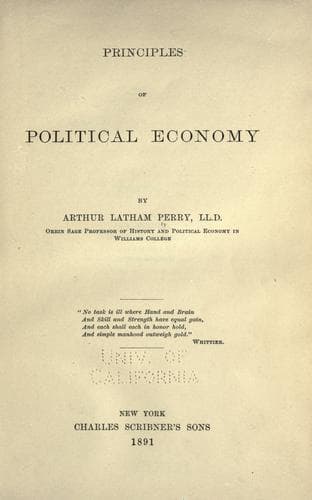
Principles of Political EconomyPerry, Arthur Latham
General
Principles of Political Economy
Perry, Arthur Latham
Economics
It is only fair to apprise the reader right here, that almost all
Economists deny that any new capital is created through Credit. These
deny _in toto_ that the relation of debtor and creditor involves
anything more than the exchange between the two parties of certain
_titles to tangible goods_. Let the reader now hear, and then judge
for himself. Bonamy Price of Oxford University, a professed Economist
and a teacher of acknowledged ability, writes as follows:[8]
"_Omitting the capital which a joint stock company puts into a bank,
the banker possesses no capital, except his premises and any coin that
may be in them, however much commercial and monetary literature may
ascribe capital to banks. Lines and names in ledgers, cheques at the
Clearing-house, debts due to depositors, debts due upon bills by
borrowers, are neither wealth nor capital. They are words and nothing
more. Incorporeal property, under which these kinds of written words
are summed up, is not wealth; it is merely a collection of
title-deeds, but from which the reality is absent. The corpus is not
in those deeds, but the right to acquire that property, even before
possession is obtained, is itself a property. If a title-deed or a
mortgage is declared to be actual wealth by Political Economy, then
the sooner it is consigned to the waste-basket, the better._"
This passage shows how the word, "wealth," tangles men up
inextricably, who, by discarding it utterly, might have become clear
thinkers and useful expositors. It also shows, that Professor Price
never analyzed Valuables into their three kinds, never thoroughly
mastered in a preliminary way the Idea that underlies Economics, never
precisely understood what Money is, and certainly never found out the
radical nature of Credit. Nevertheless, the passage just quoted really
concedes the whole matter in the present dispute,--"the right to
acquire that property, even before possession is obtained, is itself a
property,"--that is all that we claim, namely, that rights are
property, and that new rights (which are property) are created by
Credit, and that some of these new property-rights thus created may
become and do become a new Capital. These new rights, however, this
new and acknowledged "property," are not "_titles_" to any specific
valuables whatever, as Price supposed; "_a title-deed or a mortgage_"
is a totally different thing from a Credit, since the one always
describes and gives a qualified title to _some specific and tangible
thing_, while a credit-right is always a claim against _a person_; the
Roman law drew this distinction perfectly, a credit-right was a _jus
in personam_, while a title-right was a _jus in re_; the common Latin
language as spoken and written marked the difference by separate
words, a credit-right or true debt was a _Mutuum_, while a title-right
or thing loaned was a _Commodatum_; and the Law of our present
national banks explicitly recognizes this universal and fundamental
Public-domain text, read in full here on John Shaqi.
Reviews
Reviews
No reviews yet
Be the first to share your thoughts on this work.
Elsewhere in the archive
Join the Discussion
Join the discussion
Sign in to leave a comment or review.
Sign InorCreate an account