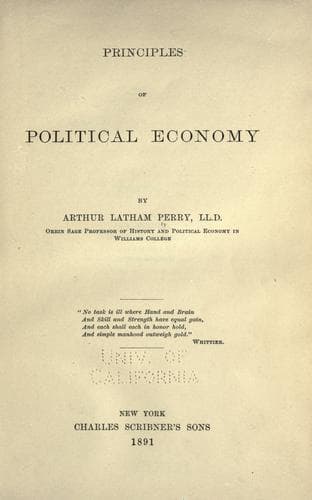
Principles of Political EconomyPerry, Arthur Latham
General
Principles of Political Economy
Perry, Arthur Latham
Economics
Is speculation proper? Certainly; if by the word "speculation" is
meant the buying of anything with an expectation based on rational
probabilities of being able to sell it again under different
conditions at a higher price. Speculation in this sense is both proper
and beneficial to the immediate parties to it, and to the general
public as well, because the values of things thus bought and sold
neither fall so low nor rise so high as they otherwise would do, which
is a public gain. Speculators as a rule buy on a falling market,
_which tends to lift it_, and sell on a rising market, _which tends to
lower it_. It is better for all concerned, that the necessaries and
conveniencies of life should bear as steady a market as is possible in
the nature of things, summer and winter, year in and year out; and the
ports of every nation should be open with the slightest possible
hindrance in the way of tax to the corresponding necessaries and
conveniencies from abroad, whenever combinations and "corners" attempt
to lift their prices beyond the level determined by a natural and free
Supply in contact with the current Demand.
Credits occupy the field of Probabilities; that is to say,
probabilities seeming to be such to men of sharp insight and
cultivated forecast. When such men _on such grounds_ buy and sell
"futures" in cotton or corn; when they buy and sell stocks either
"short" or "long"; when they seem to themselves to perceive a sound
reason for lurching over from the "bulls" to the "bears," or _vice
versa_; and when they really think that what they are wont to deal in
has touched bottom in price, and they buy now in view of a rise,
Economics has nothing to say in blame of any or all of these
operations, for they are the same in substance and motive as all other
buying and selling; but nevertheless, it has this to say, that all
these operations in credit-futures lie adjoining to and in dangerous
proximity with another field, for operations within which it has
nothing _but_ blame to utter. Gambling occupies the field of Chance.
There is a great difference between chances and probabilities.
Political Economy has no trouble in drawing a fast and hard line
between them.
Public-domain text, read in full here on John Shaqi.
Reviews
Reviews
No reviews yet
Be the first to share your thoughts on this work.
Elsewhere in the archive
Join the Discussion
Join the discussion
Sign in to leave a comment or review.
Sign InorCreate an account