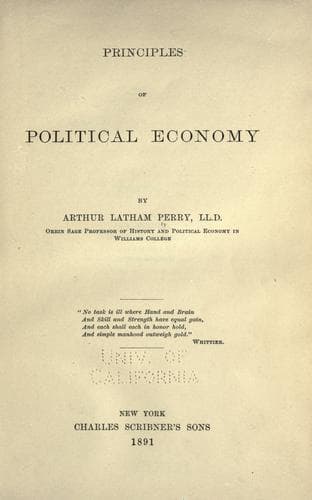
Principles of Political EconomyPerry, Arthur Latham
General
Principles of Political Economy
Perry, Arthur Latham
Economics
But practically the operators in credit-futures experience an immense
difficulty in keeping within this line of rational probabilities. The
coolest heads are apt to become heated, and to lose sight of
distinctions, in the close air of the Stock Exchange and the offices
circumjacent. Some operators openly confess they know nothing which
way the index of reason points, by buying "straddles," as they are
significantly called. A friend and old-time pupil, who has for years
been accustomed to these excitements in New York, said recently to the
writer,--"_The Stock Exchange is a great gambling hell, and that's all
there is of it!_" In buying and selling of all kinds, both sides gain:
in gambling of all kinds, what one side gains the other side loses:
therefore, under a sound money, healthful public opinion, and good
law, gambling never can become formidable. In every lottery scheme, no
matter how honestly managed, the sum of the _prices_ of the tickets is
greater than the sum of the _prizes_ offered, otherwise nothing would
be left for the profits of the managers; therefore, he would be a very
foolish man, who should buy all the tickets of a given lottery with
the certainty of drawing all the prizes; and _he_ is a still more
foolish man, who should take his _chance_ of drawing all the prizes by
buying two or ten tickets.
(4) Another and a principal Disadvantage of Credit is seen in its
usual action on _prices_ through increased Demand, and its consequent
tendency to bring about Commercial Crises. Any man's whole
purchasing-power is made up of three items: first, the property in his
possession; secondly, the values that are owed to him; and thirdly,
his credit. He can buy services of the three kinds with these three
valuables; and the sum of his power to buy is exactly measured by the
aggregate of these three valuables under his control. But while the
first two, his property and debts due, are limited and ascertainable,
the third (his credit) is indefinite and undeterminable beforehand.
Being based upon _confidence_, which is itself sensitive and variable,
a man's credit at one time may be vastly greater than at another,
compared with his other two means of purchase; and if he have the
reputation of doing a safe and regular business, and is favored by
circumstances, he will find himself able sometimes to buy on credit to
an extent out of all expected proportion to his other capital. When,
therefore, credit is offered and received for commodities, it has the
same influence upon their prices as when money is offered and received
for them. It follows, consequently, that there is likely to be a
general rise of prices whenever there is an extension of credit for
the purpose of purchasing; indeed, when money only is used to buy
with, there can not be a _general_ rise of prices, because while more
money may be spent on some things, and they rise in price, there would
be less money for other things, and _they_ would rather fall in price;
Public-domain text, read in full here on John Shaqi.
Reviews
Reviews
No reviews yet
Be the first to share your thoughts on this work.
Elsewhere in the archive
Join the Discussion
Join the discussion
Sign in to leave a comment or review.
Sign InorCreate an account