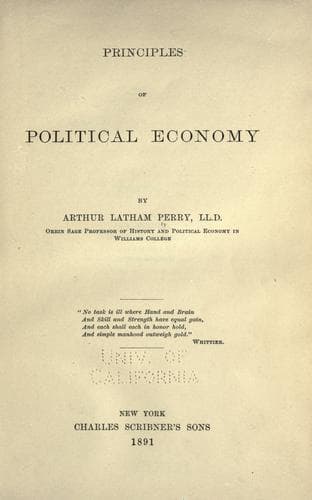
Principles of Political EconomyPerry, Arthur Latham
General
Principles of Political Economy
Perry, Arthur Latham
Economics
Mr. E. G. Spaulding of Buffalo, in his copious and excellent History
of the Legal Tender Act, "all of which he saw and part of which he
was," as the chairman of the subcommittee of the Ways and Means at
the time the Act was passed, demonstrates the extreme reluctance of
everybody concerned to give a forced circulation, that is, a
compulsory legal-tender quality, to the first batch of Treasury Notes
to the amount of $150,000,000 in February, 1862. We have already noted
in another place in this chapter, that two successive batches of
similar Notes, each to the same amount as the first, were issued
within less than a year. These Notes then and since called Greenbacks,
bore at the time four essential features: first, they were both in
terms and in reality _national Promises_ to pay to the bearer gold
dollars of the then and present standard of weight and fineness,
because there is no other possible meaning to the words "THE UNITED
STATES WILL PAY TO THE BEARER FIVE DOLLARS"; second, in addition to
their being a forced loan from the people to the amount of notes
authorized, they were given a _forced circulation_ as money by means
of the clause, "_and shall also be lawful money and a legal tender in
payment of all debts public and private within the United States
except duties on imports and interest on the national bonds_," which
clause still recognizes gold dollars as the only universal and
standard money; third, the notes were made _fundable_ in sums of fifty
dollars, "or some multiple of fifty dollars," in six-per-centum gold
bearing bonds of the United States, then called 5-20's, again in this
clause recognizing the radical difference between the legal-tender
paper promises as money and the gold dollars promised in them, in
which gold money the interest and principal of the bonded debt must
still be paid; and fourth, these notes were publicly known and
acknowledged by the Issuer and the receivers to be presently
_irredeemable_, since the Government did not have, and did not pretend
to have, any coin with which to redeem them, and everybody knew that
they were made a legal-tender _because_ they were irredeemable.
These prompt recognitions of the impassable gulf between a Promise and
what is Promised, were confirmed by all that happened afterwards. The
notes, notwithstanding they were legal tender and all bonds of the
United States could at first be bought with them at par, almost
immediately began to droop as compared with gold. The daily quotations
showed a pretty steady decline for two years. On Jan. 15, '64, gold in
greenbacks was 100:155; April 15, 100:178; June 15, 100:197; June 29,
100:250, that is, 40 cents to the dollar; and July 11, 100:285, or 35
cents to the dollar in gold, their lowest point. From this depth they
slowly rose with many fluctuations back and forth from many causes for
14 years. Jan. 1, 1879, they became redeemable in gold, and have so
continued till the present time.
Public-domain text, read in full here on John Shaqi.
Reviews
Reviews
No reviews yet
Be the first to share your thoughts on this work.
Elsewhere in the archive
Join the Discussion
Join the discussion
Sign in to leave a comment or review.
Sign InorCreate an account