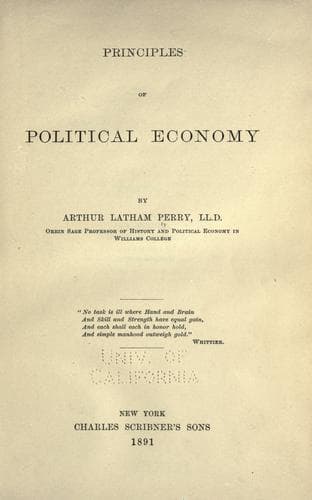
Principles of Political EconomyPerry, Arthur Latham
General
Principles of Political Economy
Perry, Arthur Latham
Economics
Besides, the men to fight the battles, and the capital by which to
feed, clothe, and furnish them the munitions of war, _must come from
that generation_; and there is always great injustice in the
manipulations of a great debt ostensibly incurred to obtain this
capital, and the debt itself is usually in large part rather a
memorial of the war than of the means by which its expenses were
actually defrayed.
The generation of American citizens not yet wholly passed off the
stage was called on in the Providence of God to suppress a Civil War
of enormous proportions, and to eradicate a social institution that
was thoroughly bad; the expense of doing this was many fold enhanced
by timorous counsels in the field, by class legislation in Congress,
and by wretched financiering in the Cabinet; but the Debt, vast as it
was, and needlessly incurred as a large portion of it was, has already
in good part been paid off and must be entirely paid off by the
generation that incurred it. That this great task may be thus
completed, will require (1) an economical administration of the
national Government; (2) an avoidance of intervention in the affairs
of our Neighbors, and of entangling alliances with Foreigners; (3) a
free Commercial System, under which the taxes shall be adjusted only
towards the most productive revenue; and (4) a constant and onerous
home Taxation.
(6) The final Disadvantage of Credit is this, that it is apt to
confuse the minds of men as to its own nature, from its apparent
resemblance to something else, which is at bottom wholly unlike it.
The people of the United States have suffered greatly from this
confusion, and are likely to suffer from it still more in the time to
come, both in their property and progress at home and in their good
name abroad; and it becomes all good citizens, and especially all
those called upon to pronounce on the Law of the Land, to know
thoroughly the radical difference between a _Credit_ and a
_Quittance_, and so to escape the contagious confusion that has
entered and stirred up the popular, and even the judicial, mind of
this country. All through the present chapter has been insisted on and
illustrated the point, perhaps to the weariness of the reader, that
Credit is always essentially the _Promise_ of one person to another,
and that whatever is thus _Promised_ is necessarily and fundamentally
different from the Promise itself. To confound those two things as if
they were or could be made one and the same thing, is in thought
illogical and in practice execrable.
And yet it must be allowed, that there is somewhat in the nature of
Credit, that makes this confusion plausible, or else it never would
prevail; and also that there is something more still to make it
plausible in the nature of Money, which last point can only be cleared
up in the next following chapter under that title.
Public-domain text, read in full here on John Shaqi.
Reviews
Reviews
No reviews yet
Be the first to share your thoughts on this work.
Elsewhere in the archive
Join the Discussion
Join the discussion
Sign in to leave a comment or review.
Sign InorCreate an account