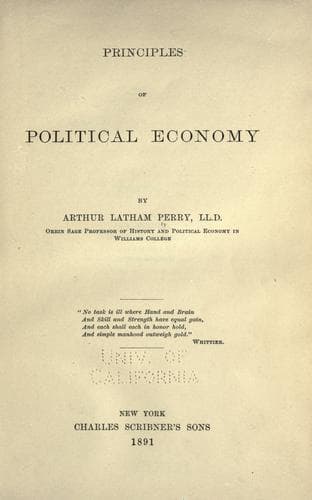
Principles of Political EconomyPerry, Arthur Latham
General
Principles of Political Economy
Perry, Arthur Latham
Economics
Salmon P. Chase was one of the greatest men of the great period of the
Civil War. He was Secretary of the Treasury at the time the greenbacks
were issued, and they were issued at his instance and advice, but he
was opposed to the clause that made the notes a legal tender. He never
expressed the opinion that the Legal-Tender Acts were constitutional,
nor did he expect that the notes, of which these authorized the issue,
would ever become a permanent national money. This is evident from the
fact that the notes were made _fundable_ at his instance, not so much
with the view of keeping up the value of the notes by giving them a
present market in bonds, as with the view that they would help the
sale of the bonds and would be absorbed by them as soon as the price
of the bonds was above par in greenbacks. Afterwards Mr. Chase thought
that this _fundability_ of the notes into bonds would so far take up
the notes as to stand in the way of the negotiation of further
necessary loans to the Government, and at his instance this provision
of the law was repealed. Consequently, there was nothing inconsistent
between his position as Secretary and his later position as Chief
Justice. He was undoubtedly right in both of these positions. The
making the greenbacks legal tender did not probably add one particle
to their purchasing-power, but rather the reverse, because that
feature implied a doubt on the part of Congress itself as to the
validity and currency of such national promises-to-pay. That he was
also right in his judicial opinion and decision, however subsequently
overruled in his own Court, may be safely left to the inevitable
future appeal to common sense and to the common principles of
constitutional interpretation.
This judgment in Hepburn _versus_ Griswold was favorably received by
the country at large, as being just in the line of the great decisions
of Chief Justice Marshall, and as being exactly in accordance with
Amendment X of the Constitution, namely, "THE POWERS NOT DELEGATED TO
THE UNITED STATES BY THE CONSTITUTION, NOR PROHIBITED BY IT TO THE
STATES, ARE RESERVED TO THE STATES RESPECTIVELY, OR TO THE PEOPLE."
The State of Massachusetts particularly, which has always maintained
and still maintains a strong doctrine of State Rights as over against,
though in harmony with, the Rights of the United States under the
Constitution, applauded this judgment as sound in law and politics,
and as righteous altogether. But the then administration of General
Grant, inexperienced alike in law and politics, and linked in
entangling alliances with the great corporations of the country,
received the Decision with marked dissatisfaction; and it was
especially offensive to the huge railroad companies, whose bonds had
been executed prior to Feb. 25, 1862, inasmuch as it made the
principal and interest of these bonds payable in coin, which they had
hoped to pay off in the depreciated greenbacks, made legal tender for
all debts.
Public-domain text, read in full here on John Shaqi.
Reviews
Reviews
No reviews yet
Be the first to share your thoughts on this work.
Elsewhere in the archive
Join the Discussion
Join the discussion
Sign in to leave a comment or review.
Sign InorCreate an account