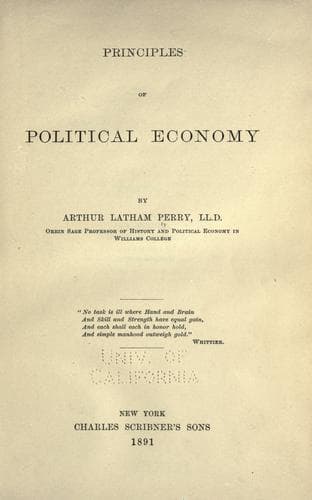
Principles of Political EconomyPerry, Arthur Latham
General
Principles of Political Economy
Perry, Arthur Latham
Economics
The Administration lost no time in trying to bring about by fair means
or foul, a reversal of this unwelcome decision. E. R. Hoar of
Massachusetts, at that time attorney-general in Grant's Cabinet, was
the principal agent in accomplishing this end by means so
discreditable that he lost in consequence his popularity in
Massachusetts and all chance of further political preferment. The
means chosen and put into effect was the appointment by the President
of two new judges, Strong and Bradley, the first to take the place of
Grier, resigned, and the second appointed under a law increasing the
number of judges to nine, whose opinions on the point at issue were
known beforehand, and who were selected to serve on that very account.
"_It was no secret, indeed it was a matter of public notoriety, that
these justices were appointed in order that the decision of 1869
might be reversed. Their opinions in regard to the constitutionality
of the Legal-Tender Acts had been clearly and publicly expressed. It
was therefore pretty well known what the decision would be when the
question was again presented._" (Hugh McCulloch.)
The second Legal-Tender case, accordingly, that of Knox _versus_ Lee,
decided in December, 1870, reversed the judgment of a year before, _no
new points therefor being raised either by the new judges or by
counsel in the new trial_, the Chief Justice and his three former
associates still adhering to their original opinions. It was then five
judges to four, the special question being, Is it constitutional to
make promises-to-pay a legal tender on contracts executed before the
promises were issued? The judicial answer was in this case, Yes;
provided Congress regarded such action as a necessary means of
preserving the Government in time of War, or any other period of
extraordinary emergency. That is to say, _bona fide_ creditors were
constitutionally bound to receive depreciated notes as legal tender in
satisfaction of contracts entered into when no notes were in
existence; to receive on contracts specifically calling for
"_dollars_" the depreciated notes of the Government merely promising
to pay "_dollars_," but on which the "_dollars_" could not be
obtained! What is that, but the monstrous incongruity that _a promise_
is the same thing legally as its _fulfilment_? What is that but
judicial blindness as to the _nature_ of Credit? What is it but the
old confusion between _names_ and _things_? What is it, finally, but
the dazed and hazy vision, pardonable perhaps in the popular mind but
half-opened to radical distinctions, but unpardonable in learned men
professing to lay down the law in a civilized country?
Public-domain text, read in full here on John Shaqi.
Reviews
Reviews
No reviews yet
Be the first to share your thoughts on this work.
Elsewhere in the archive
Join the Discussion
Join the discussion
Sign in to leave a comment or review.
Sign InorCreate an account