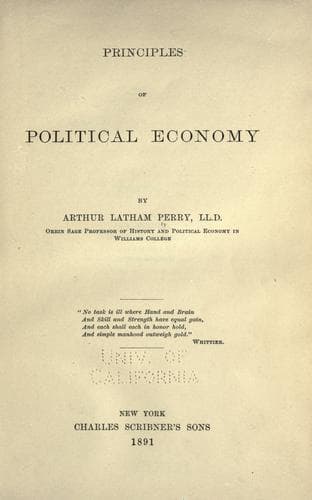
Principles of Political EconomyPerry, Arthur Latham
General
Principles of Political Economy
Perry, Arthur Latham
Economics
1. Economical Exchanges may begin, be profitable to both parties, and
go forward to a certain extent, without the use of any money at all.
As a matter of fact and probably for a long time, while the
Civilizations were gathering their inchoate forces for a further
progress, men exchanged one Service directly for another without the
intervention of any medium. This form of trade is called Barter. King
Hiram of Tyre furnished to King Solomon of Judea a certain quantity of
cedars from Mt. Lebanon for the building of the new Temple at
Jerusalem, and Solomon in return furnished to the Tyrians a certain
quantity of wheat and oil, Judea being a fertile agricultural country
with no forests, and Tyre a wooded country with no farms. This may
well serve us as an instance of Barter, although Money had been in
current use in those regions a thousand years before, as is seen in
the purchase by Abraham of the cave and field of Machpelah, for which
he weighed out "_four hundred shekels of silver, current money with
the merchants_."
It is obvious, however, that while Barter is a good deal better than
no exchanges at all, there are inherent and immense difficulties in
that form of trade.
(a) Under Barter trade is extremely limited in its _personnel_. Only
those parties can engage in it, each of whom is in position to render
to the other just such a Service as the other is in direct and
immediate need of, and each of whom also wants another Service in kind
and quantity exactly what the second man has to render. It is not
enough under these conditions, that a man should have some Service to
sell, but he must also find some other man, who not only wants that
specific service but who also has some service to render in return
just such as the first man wants. If A has wheat which he wishes to
exchange for a coat, he must first find a party desiring wheat and
also having a coat to sell, and moreover who wants just as much wheat
as will pay for a coat, no more and no less; if he wants more, he may
have nothing to render for the excess which A is willing to accept; if
less, A may have nothing besides wheat with which to help pay for the
coat. Even in the simpler states of Society the inconveniences of thus
hunting up a specific market for each specific service are very great,
and in more advanced states of civilization would become intolerable,
if it were possible (as it is not) for Society to become advanced
under such conditions.
Public-domain text, read in full here on John Shaqi.
Reviews
Reviews
No reviews yet
Be the first to share your thoughts on this work.
Elsewhere in the archive
Join the Discussion
Join the discussion
Sign in to leave a comment or review.
Sign InorCreate an account