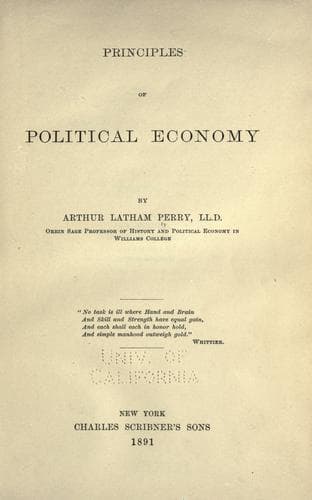
Principles of Political EconomyPerry, Arthur Latham
General
Principles of Political Economy
Perry, Arthur Latham
Economics
finished products, is more universal in its terms of generalization
than most of the propositions of Money and Taxation can be.
It seems like a paradox, that those parts of Economics in which the
human elements of variable choice may predominate over the relatively
fixed laws of nature and of mind, should be just the parts hardest for
men to catch clearly and hold firmly; because, we naturally think,
that difficulty and mystery are rather to be found in those
departments in which an Infinite Mind has been at work upon an
infinite plan, and that there is no such profundity in the works of
men; but after all, even those natural laws like Gravitation, which
are clear and universal as laws, if they be such as the devices of men
have to do with, such as may be modified and in a certain sense
controlled by human actions, become from that very circumstance liable
to some difficulty and perhaps to some mystery. Now all the truths of
Money, and as we shall see in the final chapter all the truths of
Taxation also, belong to this class of less general generalizations;
still, it is scarcely less than foolish to say, that Money is such an
elusive and ideal agent that nobody can understand it. That is the
language of indolence and lack of penetration. Money is wholly a
matter of man's device, though it comes into constant contact with
something greater and more fixed than itself; it was invented, just as
any other instrument is invented, to accomplish a certain economical
purpose; and it would be strange indeed if men by taking pains could
not perfectly comprehend what men themselves have wholly devised. We
hope, accordingly, in the following paragraphs to clear up completely
to all intelligent readers the whole doctrine of Money. The key to
unlock all the superficial difficulties (and there are no others) is
this: Money is always a Valuable before it becomes money, and
continues a valuable independently of the fact that it _is_ money;
and, it is always one or other of two kinds, either itself a Commodity
or a Promise to pay a commodity. In this chapter, we will not begin
with definitions and justify them afterwards, but will come up to them
step by step, and, as it were, justify them beforehand.
Public-domain text, read in full here on John Shaqi.
Reviews
Reviews
No reviews yet
Be the first to share your thoughts on this work.
Elsewhere in the archive
Join the Discussion
Join the discussion
Sign in to leave a comment or review.
Sign InorCreate an account