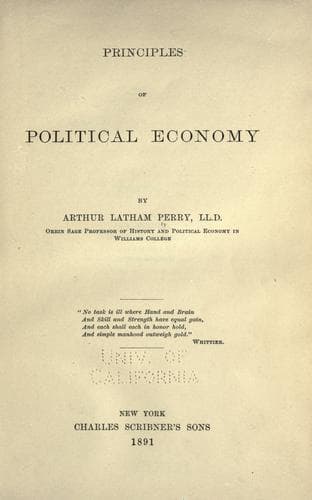
Principles of Political EconomyPerry, Arthur Latham
General
Principles of Political Economy
Perry, Arthur Latham
Economics
(a) Perhaps it will help us to find out precisely what Value _is_ by
seeing as clearly as possible at the outset what it is _not_. It is
not _easy_, and never can be made so, to teach and to learn distinctly
what Value is in its ultimate nature and constant changes. Here is the
one unavoidable difficulty that lies at the very threshold of
Political Economy; and this difficulty, which is not found as in the
case of "Wealth" in the meaning of the word but in the complex
character of that which the word describes, once overmastered, and one
walks thereafter with ease and pleasure throughout the economic
domain. It would be wrong and cruel to deny that just here is one hard
place in the road for teacher and pupils to get over. It arises wholly
from the nature of the subject, as we shall soon see, and not at all
from the insufficiency of the word, Value. We have already seen fully,
that Buying and Selling in each and every transaction is complex and
relative, involving twelve elements every time; that Desires and
Estimates and Renderings are especially relative,--each party to a
trade desires something in possession of the other, estimates that
something relatively to something in his own possession, and finally
renders to the other his own something for the sake of receiving the
other's something. Now everybody is used to all this and practically
understands it perfectly, but it is complicated and reciprocal
nevertheless, and Value, which is the single birth of the two
Renderings, though perfectly intelligible to him that takes pains, is
not a thing to be seized once for all at a passing trot.
Value, then, is _not_ a quality of single things, belonging to them as
if by nature, as hardness is a quality of a rock or gravity is an
attribute of gold; because all physical qualities in physical things,
all that which makes or helps to make anything such as it is, may
be learned by a study of the things themselves by themselves; a
careful examination and analysis of the mechanical and chemical
properties of any physical thing will discover all its distinguishing
characteristics, all that makes it that particular thing in
distinction from all other things; but it is plain already, that the
_Value_ of anything (if it have value) cannot be found out by studying
that particular thing by itself alone; the questioning of the senses
however minute, the test of the laboratory however delicate, can never
determine how much anything is _worth_, because that always implies a
comparison between _two_ things, or more strictly a comparison between
two Renderings in exchange. Value is not an attribute of single
things: not even if the things be physical and tangible.
Public-domain text, read in full here on John Shaqi.
Reviews
Reviews
No reviews yet
Be the first to share your thoughts on this work.
Join the Discussion
Join the discussion
Sign in to leave a comment or review.
Sign InorCreate an account