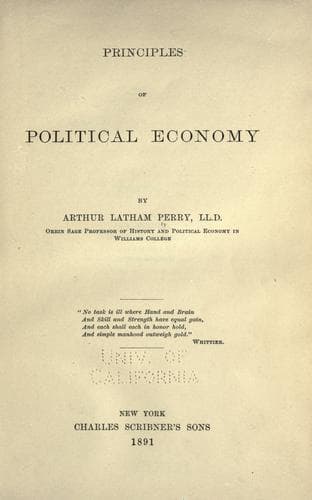
Principles of Political EconomyPerry, Arthur Latham
General
Principles of Political Economy
Perry, Arthur Latham
Economics
The present word is derived from the Latin VALERE, _to pass for, to be
worth_. There is a strong hint of a _comparison_ in the original
meaning of the word, and the current use of it both in Latin and
English develops the hint into a certainty. In common language, when
the Value of anything is asked for, the answer always comes in the
terms of something else. If the question be, How much is it worth? the
answer is, So many dollars or cents. Now the cents or dollars are very
different things from those whose value is thus inquired after; and so
we see again from another point of view that Value is a relative
matter, since it clearly implies a comparison between two distinct
things; and, if so, it is clearly enough not a quality of any one
thing, and of course it would be useless to try to ascertain the Value
of anything by a study of that thing alone. Etymology thus easily
brings us up to our present vital question, and will assist us to
solve it completely.
(c) _What is Value?_ Plainly it is the result of a comparison
instituted between two things, using the word, "things," here in its
broadest sense. But who institutes the comparison? And who is
competent to announce the result of it in Value? A comparison is
required in order to ascertain the length of a stick of timber in feet
and inches, and a carpenter's square is the instrument by which the
comparison is made, and it makes no difference in the result whose the
square is or whose the stick of timber is, since the square and the
stick have in common the physical quality of length, and a simple
comparison of square with stick determines the length of the latter,
and one man in this case may determine the result by himself alone,
and it is not needful that he be the _owner_ of either of the things
compared.
But it is a different kind of comparison from this that issues in
Value. Let us suppose an exchange of a bushel of wheat for a mason's
trowel: there is no common physical quality, as length, between the
wheat and the trowel; and it is evident, that no _one_ man can measure
in any form one of these two commodities by means of the other. It is
a peculiar kind of comparison that is involved in any and every trade;
and the first peculiarity of it is, as we have already seen in another
connection, that it always requires "two persons" to make it; and each
of the two persons must always be the virtual _owner_ of one of the
two things exchanged. A thief may indeed go through the motions of
selling a stolen horse, but as he is not the owner of the horse there
can be no sale, and the actual owner may take his horse wherever he
finds it even in the hands of an innocent third party. In other words,
there must ever be "two efforts" also, two legitimate efforts giving a
valid claim of ownership to each of the two parties in the exchange.
Public-domain text, read in full here on John Shaqi.
Reviews
Reviews
No reviews yet
Be the first to share your thoughts on this work.
Join the Discussion
Join the discussion
Sign in to leave a comment or review.
Sign InorCreate an account