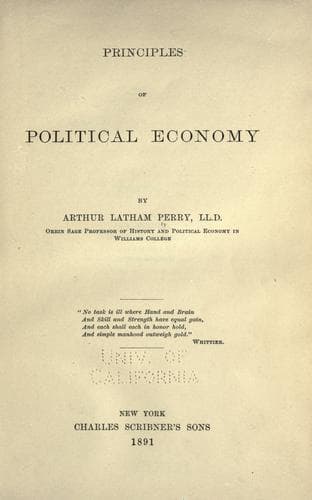
Principles of Political EconomyPerry, Arthur Latham
General
Principles of Political Economy
Perry, Arthur Latham
Economics
"Demand" is a technical term in Economics, and accordingly needs to be
defined, and then always used in its defined sense. So is "Supply."
_Demand is the "desire" of a "person" for something in the hands of
another person, coupled with the possession of something else capable
of buying that something._ Mere desire has no function in Political
Economy: hungry and penniless children passing by the stalls of a
great market, have no influence on the prices or values of the viands,
on which they cast their eager glances: only desires accompanied by
"efforts" competent to excite the desires and to pay for the efforts
of another are a Demand. Supply is the same thing as Demand looked at
from the other side. Supply is the correlative of Demand. The Supplyer
is a person, who has in his possession something desired by the
Demander, and who in turn desires something in the hands of the
Demander, when both are willing to exchange their "renderings." There
is no economical difference in the position of the Demander and the
Supplyer. Each is equally a Demand and a Supply with reference to the
other. It is the old and ever-recurring case of Value, the
propositions being here stated in their most universal terms.
For simplicity's sake, however, and for convenience, without altering
the substance of the definitions a particle, the valuables when looked
at as a Demand are practically reduced in all markets to their
equivalent in Money, so that Money offered or ready to be offered
against any other exchangeable thing constitutes what is called in
commercial language a Demand; and this is sufficiently accurate as
well as current, although it must always be remembered that each
valuable in any market in reality constitutes a Demand for another,
and is equally a Supply in reference to that other. _Supply is any
exchangeable thing offered for sale against any other exchangeable
thing._ For example, corn in any market is at bottom a Demand and a
Supply at once for every valuable offered in that market at that time,
say, ploughs for one thing; but in the talk of the market, the
presence of corn there, or its being ready to be immediately brought
there and offered in exchange for money, constitutes what is called a
Supply of corn; money offered, or ready to be offered, in exchange for
corn, constitutes what is called a Demand.
Public-domain text, read in full here on John Shaqi.
Reviews
Reviews
No reviews yet
Be the first to share your thoughts on this work.
Join the Discussion
Join the discussion
Sign in to leave a comment or review.
Sign InorCreate an account