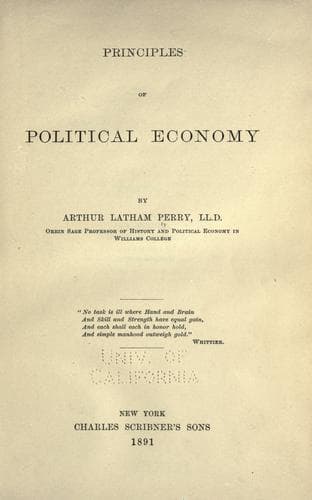
Principles of Political EconomyPerry, Arthur Latham
General
Principles of Political Economy
Perry, Arthur Latham
Economics
(4) _Feigned Cases._ There are two kinds of these, namely, those which
might be realized in actual fact, and those which never can be so
realized. The acute mind of the Greeks marked in their flexible
language a decided difference between the class of suppositions that
might possibly become facts, and another class of suppositions
impossible to become facts, by developing a distinct form of expression
for each. This distinction must always be borne in mind by those who
use or note in economical discussions the expedient of Feigned Cases.
Reasoning is always legitimate and often pregnant from suppositions,
whenever these are such as might readily become facts of experience,
because in that case the argument proceeds upon recognized and
inductive resemblances; but otherwise, no inference at all can be drawn
from them, because it is an universal truth in Nature and in Logic, _ex
nihilo nihil fit_, out of nothing nothing can come. In plausible
suppositions impossible to become facts is a nest of logical fallacies,
that need to be watched. A good illustration may be found in the
Monetary Conference at Paris in 1881. Delegates were there from all the
nations of Europe, from the United States, and even the distant India.
Some of these in their eagerness for a factitious ratio of value
between gold and silver forgot the important distinction now in hand,
and argued of the good results to flow from the realization of a
supposition, _which in fact never could be realized_. Mr. Evarts voiced
the French and American delegates in this declaration: "_Any ratio now
or of late in use by any commercial nation, if adopted by an important
group of states, could be maintained; but the adoption of a ratio of
15-1/2 silver to 1 of gold would accomplish the principal object with
less disturbance in the monetary systems to be affected by it than any
other ratio._" The fallacy in this passage is in the words, "could be
maintained," which are a supposition, and what is much worse, a
supposition contrary to fact, from which all arguing is nugatory. Why
it is contrary to fact will be seen at length in the following chapter
on Money.
Public-domain text, read in full here on John Shaqi.
Reviews
Reviews
No reviews yet
Be the first to share your thoughts on this work.
Elsewhere in the archive
Join the Discussion
Join the discussion
Sign in to leave a comment or review.
Sign InorCreate an account