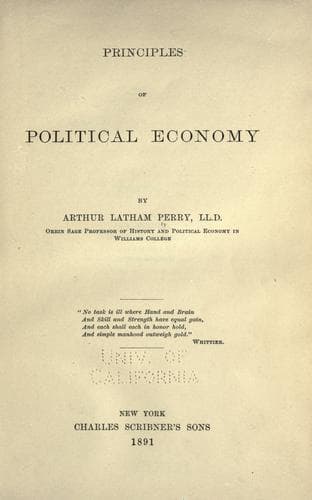
Principles of Political EconomyPerry, Arthur Latham
General
Principles of Political Economy
Perry, Arthur Latham
Economics
On the other hand, a supposition that may clearly become a fact is a
substantive thing, and logical inferences may be drawn from it, just
as geometrical inferences may be drawn from a _supposed_ circle: the
circle on the page is not a _perfect_ circle--no such circle was ever
drawn--but _suppose_ it perfect, as it might possibly be, and argument
becomes at once valid. Let us take another Monetary Conference at
Paris in 1867 as an illustration: its judgment as voiced by Mr.
Ruggles of New York was taken with logical propriety, when the great
benefits of an international coinage of gold alone were argued and
announced, because, while that was then a mere conjectural project, it
was possible any day by mutual agreement among the nations to become a
reality. An international coinage of gold is a simple question of
equivalence of _weights_ in the coins of different countries: an
equivalence of _values_ as between gold and silver coins for any great
length of time is neither simple nor possible.
(5) _Results measurable in numbers._ The four preceding logical
processes of proof and construction Political Economy is glad to share
with the other Moral Sciences, but this fifth and last one it has to
itself alone, and this is its chief scientific advantage over them,
and is consequently the main reason why it is already more advanced
and more symmetrically developed than any of them. In common with them
it has important subjective elements, such as Desires, Estimates, and
Satisfactions; in marked advantage over them it has also objective
elements, that can be weighed and measured and even hardened into
statistics. Economics has an ever ready objective test, which mere
mental and ethical and other moral processes never can have from their
very nature. The _result_ of each and of all economic transactions may
be measured by money, and put down in a ledger, and published to the
world in the form of statistics. An economic blunder, whether in
legislation or in private action, pretty soon proves itself to be such
by the lessened gains of somebody, and these losses can be stated
arithmetically; and similarly, an economic improvement evidences
itself at once by increased gains coming to somebody; while it may
take years and years to work out the results of an ethical mistake,
and even then their amount can only be guessed at.
Public-domain text, read in full here on John Shaqi.
Reviews
Reviews
No reviews yet
Be the first to share your thoughts on this work.
Elsewhere in the archive
Join the Discussion
Join the discussion
Sign in to leave a comment or review.
Sign InorCreate an account