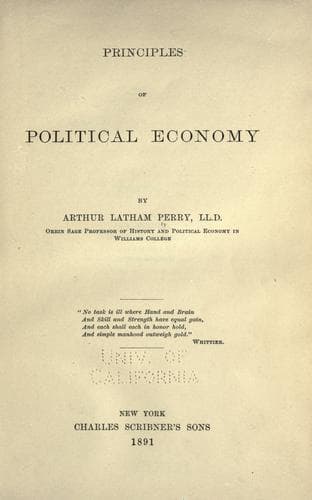
Principles of Political EconomyPerry, Arthur Latham
General
Principles of Political Economy
Perry, Arthur Latham
Economics
Valuables fall naturally and exactly into three classes, Commodities,
Services, and Credits. The reasons are obvious at first glance, why
articles falling in the first class occupied the thoughts and the
efforts of men almost exclusively for the first thousand years of
recorded history. Commodities appealed to the senses of men: they are
visible, tangible, weighable. Some form of personal slavery existed
everywhere, and largely withdrew attention from personal services
bought and sold; and there was not apparently sufficient personal
confidence between man and man in the earlier ages to allow much
development of credits, whose ground is personal trust and whose
sphere is future time. Commodities, on the other hand, fitted by the
efforts of some men to satisfy the immediate wants of other men, all
ready for delivery, to be exchanged against other commodities
similarly fitted and at hand, took the field apparently in the
earliest ages of recorded Time, gradually became very large in volume,
opened new routes of travel and transportation, and served to connect
in a rough and ready way neighboring tribes and even neighboring
nations.
_Commodities are the class of Valuables comprising material things,
organic and inorganic, fitted by human efforts to satisfy human
desires._ Cattle were probably among the first things to become
valuable, that is, salable; and it is certain, that they became very
early in many quarters of the world a sort of Money or standard of
comparison among other things exchangeable, and indeed they continue
to be such in some quarters to this day. Near the middle of the sixth
book of the Iliad occur these lines:--
"Then did the son of Saturn take away
The judging mind of Glaucus, when he gave
His arms of gold away for arms of brass
Worn by Tydides Diomed,--_the worth
Of fivescore oxen for the worth of nine_."
Gold and silver also became valuable in the ordinary way in very early
times, and later became Money or a medium in exchanging other things;
and much later other metals came into use as commodities and then too
as money; for the Latin word for money, _pecunia_, derived from
_pecus_, cattle, seems to imply some original equivalence in value
between the bronze stamped with the image of cattle and the cattle
themselves. Parcels of land subdued and improved by human hands were
probably bought and sold in some portions of the world as early as
anything was,--at any rate very early. Land-parcels are a commodity
under the definition. Another passage from Homer, towards the end of
the seventh book of the Iliad, displays some of the commodities in
common use during the heroic age in Greece:--
"But the long-haired Greeks
Bought for themselves their wines; some gave their brass,
And others shining steel; some bought with hides,
And some with steers, and some with slaves, and thus
Prepared an ample banquet."
Public-domain text, read in full here on John Shaqi.
Reviews
Reviews
No reviews yet
Be the first to share your thoughts on this work.
Elsewhere in the archive
Join the Discussion
Join the discussion
Sign in to leave a comment or review.
Sign InorCreate an account