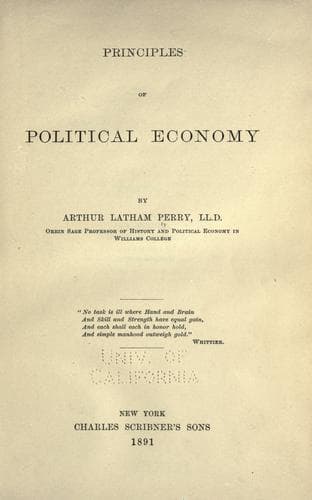
Principles of Political EconomyPerry, Arthur Latham
General
Principles of Political Economy
Perry, Arthur Latham
Economics
The earliest detailed record of a commercial transaction in
commodities, is the purchase by Abraham of the field and cave in
Hebron, more than 2000 years before Christ. It is narrated at length
in Genesis xxiii. Long before this purchase, however, it is said of
Abraham that he "went up out of Egypt very rich in cattle, in silver,
and in gold." This formal sale to him in Hebron of the field and cave
of Machpelah is in all its parts instructive to us, and full of signs
of the drift of those times. It was "_in the audience of the sons of
Heth, before all that went in at the gate of his city, that the field
and the cave were made sure unto him for a possession. And Abraham
weighed unto Ephron the silver which he had named in the audience of
the sons of Heth, four hundred shekels of silver, current money with
the merchant._" In the lack of written and recorded deeds to
land-parcels, as we have them now, the sale of them was "_made sure_"
before the faces of living men, who would tell the truth and pass on
the word. The market-place in those days was "_at the gate of the
city_," where the judges also used to hold their courts, the place
most frequented of all, and sales were made "_before all that went
in_" thither; "_in the audience of the sons of Heth_" was the silver
weighed out, and the field made sure in exchange. Then there were
"merchants" as a class; silver passed by weight rather than by tale,
although it had already passed beyond a mere commodity and had become
money, "_current money with the merchant_"; and even at this day the
Bank of England takes in and pays out gold and silver by balance
rather than by count, though they be in coined money: it is the more
accurate method.
The author of the book of Job, believed to be of great antiquity, and
certainly true to nature and to fact in its essential parts, knew very
well the modes in which the ancient mines were wrought, and the worth
of the commodities extracted:--
"Truly there is a vein for silver,
And a place for gold, which men refine.
Iron is obtained from earth,
And stone is melted into copper.
Man putteth an end to darkness;
He searcheth to the lowest depths
For the stone of darkness and the shadow of death.
From the place where they dwell they open a shaft;
Forgotten by the feet,
They hang down, they swing away from men.
The earth, out of which cometh bread,
Is torn up underneath, as it were by fire.
Her stones are the place of sapphires,
And she hath clods of gold for man.
The path thereto no bird knoweth,
And the vulture's eye hath not seen it;
The fierce wild beast hath not trodden it;
The lion hath not passed over it.
Man layeth his hand upon the rock;
He upturneth mountains from their roots;
He cleaveth out streams in the rocks,
And his eye seeth every precious thing;
He bindeth up the streams, that they trickle not,
And bringeth hidden things to light."
Public-domain text, read in full here on John Shaqi.
Reviews
Reviews
No reviews yet
Be the first to share your thoughts on this work.
Elsewhere in the archive
Join the Discussion
Join the discussion
Sign in to leave a comment or review.
Sign InorCreate an account