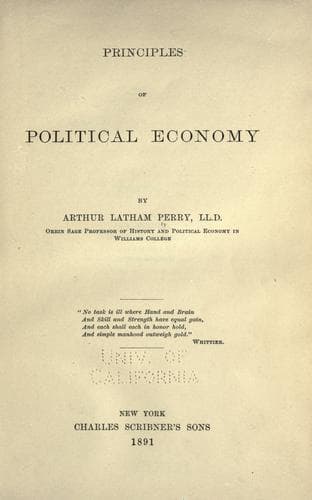
Principles of Political EconomyPerry, Arthur Latham
General
Principles of Political Economy
Perry, Arthur Latham
Economics
Natural Agents include not only "Nature's sun and showers," but also
all the forces and fertilities and materials of free Nature, that men
may and do avail themselves of in preparing commodities to exchange
with the commodities of other men. Of higher rank in Production than
these natural agencies are the Efforts of men in molding them so as to
answer other men's Desires, of which efforts the "toiling hands" of
the poet are a symbol. They include also the inventive brains and
eloquent tongues and the skilful manipulations of every name. The
poet's "ship" is an instance of capital, which is always a result of
previous toil reserved to help on some future sales. These three
elements, Nature, Labor, Capital, conspire in all production of
commodities. Nature comes first with her free forces and materials;
and then present toil aided by the results of past toil in the form of
capital does all the rest in getting commodities ready to sell and
selling them. Let us now note each of these three a little more
closely.
(a) Natural Agents. The most important point about these is, that they
are the free gifts of God, and continue so throughout the
complications and transformations wrought on them and through them by
Labor and Capital, until the material commodity of whatever kind is
finally sold, and so passes out of the purview of our Science. Many of
the gifts of God, like the air we breathe and the light in which we
recreate ourselves and the water of refreshment drunk from spring or
brook, do not connect themselves in any way with commodities bought
and sold, and nobody ever thinks of them as salable at all; but it has
seemed and still seems to many, as if the natural fertility in a
land-parcel, the water-fall along the course of river or stream, the
timber-growth which the hand of man planted not, the deposit of gold
or coal in the bowels of the earth, and other such-like cases in which
natural gifts _do_ connect themselves with human services and then are
sold, lifted the Value of the things sold above the point to which the
mere human efforts, whether past or present, would raise it. In point
of fact, this seeming is not a reality, as will fully appear in the
sequel. God is a Giver, and never a Seller; and he has arranged it so
in his great world of gifts, that, however much shrewd men may try to
monopolize these gifts and then dole them out to other men for pay,
they are always practically thwarted in the attempt. God himself never
takes pay for anything, and has never authorized anybody to take pay
in his behalf; and when this role of Seller of free gifts, which have
cost him nothing and which he has not improved, is taken up by any
one, he is shortly crowded off the stage in shame by other actors true
to Nature.
Public-domain text, read in full here on John Shaqi.
Reviews
Reviews
No reviews yet
Be the first to share your thoughts on this work.
Elsewhere in the archive
Join the Discussion
Join the discussion
Sign in to leave a comment or review.
Sign InorCreate an account