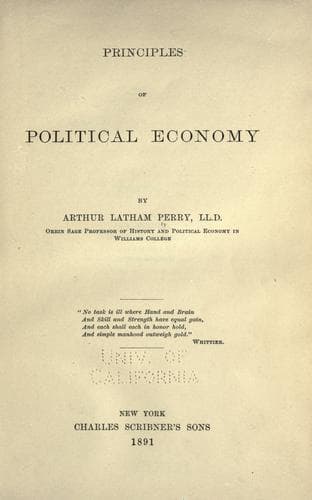
Principles of Political EconomyPerry, Arthur Latham
General
Principles of Political Economy
Perry, Arthur Latham
Economics
The prophet Ezekiel, who wrote in the sixth century before Christ,
incidentally described in his chapter xxvii the commerce in
commodities, that then centered in the city of Tyre on the eastern
Mediterranean. "_All the ships of the sea with their mariners were in
thee to traffic in thy merchandise: many islands were at hand to thee
for trade: with silver, iron, tin, and lead, they traded in thy fairs:
they brought thee for payment horns of ivory and ebony-wood._" Among
the commodities besides these exchanged in that market, are mentioned
by the prophet horses and mules and lambs and rams and goats, wine of
Helbon and white wool, fine linen and embroidered work, and riding
cloths and mantles of blue and chests of damask and thread, wheat and
pastry and syrup and oil and balm, precious spices and cassia and
sweet reed, and gold and carbuncles and corals and rubies. These old
Phoenicians of Tyre colonized Carthage, and thus bore a vast trade in
commodities to the West, going overland into the heart of Africa for
dates and salt and gold-dust and slaves, and by sea through the
Pillars of Hercules northward to the British Isles for the sake of the
trade in tin.
The amount of transactions in commodities, the first class of
Valuables, has been constantly increasing, under natural impulses
which we shall have shortly to describe, from the dawn of authentic
History down to the present moment; and figures are baffled in
expressing to our minds the sum of these transactions even in a single
country, still more their aggregate in the commercial world. The
foreign trade of every country is almost exclusively in commodities,
and is only a small fraction of its domestic trade in the same; and
so, when we remember that the foreign trade of the United States, for
example, under a commercial system designed and adapted to curtail
such trade, amounted in 1889 to about $1,600,000,000, and the foreign
trade by Great Britain the same year to about 4,000,000,000, we gain a
glimpse, we touch as it were the hem of the garment, of the gigantic
traffic of the world in commodities alone.
_The Production of Commodities is the getting them ready to sell and
the selling them._
1. We must look first at the REQUISITES of such production. They are
three, _Natural Agents_, _Human Efforts_, _Reserved Capital_. The
following lines of Whittier touch incidentally on these three
requisites, and may serve us as a general introduction to them:--
"Speed on the ship!--But let her bear
No merchandise of sin,
No groaning cargo of despair
Her roomy hold within.
"No Lethean drug for Eastern lands,
No poison-draught for ours:
But honest fruits of toiling hands,
And Nature's sun and showers!"
Public-domain text, read in full here on John Shaqi.
Reviews
Reviews
No reviews yet
Be the first to share your thoughts on this work.
Elsewhere in the archive
Join the Discussion
Join the discussion
Sign in to leave a comment or review.
Sign InorCreate an account