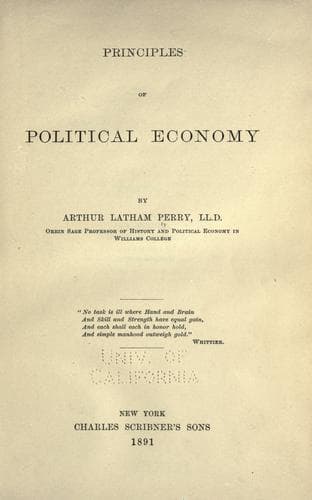
Principles of Political EconomyPerry, Arthur Latham
General
Principles of Political Economy
Perry, Arthur Latham
Economics
What has been observed to be true in respect to two or three or more
of the classes of God's free gifts _to_ men, or _in_ men, may almost
certainly be inferred to be true of all such classes. Therefore,
inductively, _such free gifts have no effect on Values to lift them,
their influence being eliminated by human competition_. Of course, if
there be unique cases of remarkable gifts, falling in no class,
subject consequently to no competition, one cannot say confidently
that the free element in conjunction with the onerous element may not
make the return-service greater than it would be otherwise. It may,
or it may not, make it greater. There is no living principle at work
in such cases, that makes it certain, that the return-service will
_not_ be greater. Still, unique cases, if they exist, are of little or
no consequence in Economics. They are most remarkably few, at all
events. Where come in the solitary gifts, that may later be connected
with Valuables, on the round earth as God fashioned it? Gold, silver,
diamonds, copper, coal, tin, amber, spice-shrubs, chinchona-trees, and
all such things, have been scattered too widely and liberally for
individuals to monopolize them, or even combinations of men unless
they be assisted by law. Where even are the unique cases of God-given
talent or genius in men themselves, such as may become connected with
Valuables of the second class? Daniel Webster had his competitors in
the Court-room and in the Senate, Ben Jonson did not let Shakspeare
have it all his own way on the stage, and even "Milton's starry
splendor" did not make Paradise Lost sell well.
Public-domain text, read in full here on John Shaqi.
Reviews
Reviews
No reviews yet
Be the first to share your thoughts on this work.
Elsewhere in the archive
Join the Discussion
Join the discussion
Sign in to leave a comment or review.
Sign InorCreate an account