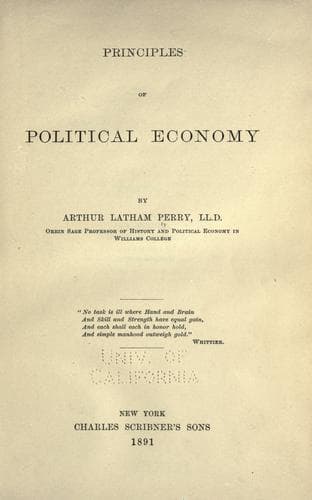
Principles of Political EconomyPerry, Arthur Latham
General
Principles of Political Economy
Perry, Arthur Latham
Economics
We must just note here in passing the supreme importance in an
economical point of view of untrammelled competition in the sale of
commodities. It is the divinely-appointed means, and the only possible
means, of preventing wide-spread injustice through Monopoly. Nothing
else in the world can be made effective to estop men from robbing
their fellow-men through exchanges artificially restricted; from
charging more in the market for their wares than a just compensation
for their own efforts; from enriching themselves by impoverishing
their neighbors; from worsening the quality of their wares offered for
sale; and from relying upon the artificial restrictions put on their
competitors, rather than on their own skill and enterprise and the
goodness of their goods, for a market. The Common Law of England holds
monopolies to be illegal, and the reasons given (11 Coke, 84) are,
first, because the price of the commodity will be raised; second,
because the quality of the commodity will not be so good and
merchantable as it was before; and third, because they are apt to
throw many working people out of employment. It is nothing less than a
crime against Civilization, than a sin against the clear ordinance of
God, than an artificial obstruction to individual and national
Progress, to put up bars and barriers by law for the purpose of
cutting off competition, whether domestic or foreign, either by
putting disabilities in the path of any or through monopoly
tariff-taxes, in the buying and selling of useful commodities
anywhere.
(b) Human Efforts. Every way unlike the free forces and materials of
Nature, indispensable as these are in the production of commodities,
is the second requisite in such productions, namely, the onerous
efforts of men. Persons are very different from things, from powers,
from lifeless materials. Persons act from motives only. Minds lie back
of bodily exertions, impelling and guiding them. Such efforts as are
needful to mold materials into commodities are only put forth in view
of, and for the sake of, a remunerative return; and only rational
beings, acting under motives whose goal is in the future, capable of
foresight and of adapting means to ends, can put forth such efforts.
No degree of training can make even the most intelligent animals
capable in any degree of that kind of exertion, which we call _Labor_;
and there is no improvement whatever in the methods of animals in
reaching their instinctive ends,--the beaver builds his dam and the
bee gathers and deposits the honey exactly as bees and beavers did
ages ago.
Public-domain text, read in full here on John Shaqi.
Reviews
Reviews
No reviews yet
Be the first to share your thoughts on this work.
Elsewhere in the archive
Join the Discussion
Join the discussion
Sign in to leave a comment or review.
Sign InorCreate an account