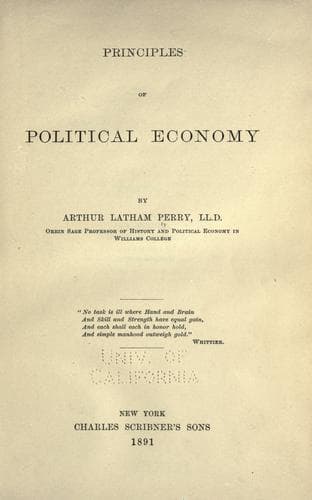
Principles of Political EconomyPerry, Arthur Latham
General
Principles of Political Economy
Perry, Arthur Latham
Economics
Capital assumes but two economical forms, namely, Circulating Capital
and Fixed Capital. _Circulating Capital is all those capitalized
products, whether commodities or credits, the returns for the sale or
use of which are derived at once and once for all._ All circulating
capital will be found in one or other of the following sub-forms: (1)
raw materials; (2) wages paid out in view of an ultimate profit; (3)
completed products on hand for sale; and (4) products bought and held
for the sake of resale. The crucial test of circulating capital is the
question, Are the returns to be secured by the single use or single
transfer of that particular product? Tools, for example, in the hands
of him who has manufactured them for sale is circulating capital.
_Fixed Capital is all those capitalized products, which are purchased
or held with a view of deriving an income from their delayed and
repeated use._ All fixed capital will probably be found in one or
other of the sub-forms following: (1) tools and machinery in use; (2)
buildings used for productive purposes; (3) permanent improvements in
land parcels; (4) investments in aid of locomotion and transportation;
(5) products rented or retained for that purpose; and (6) the national
money considered as a whole.
2. We will next look at the essential CONDITIONS of the production of
Commodities. These are also three, as are the Requisites, namely,
_Association_, _Invention_, _Freedom_. More or less will men make and
sell to one another commodities in any state of society, in which
there is permitted any considerable degree of association of men with
men locally or commercially, in which is encouraged in any way the
universal spirit of invention or the desire to get hard things done
easier, and in which some degree of liberty of action and security of
property and equality of privileges is guaranteed; but it is very
plain, that the production of commodities will increase in all
directions and become the greatest in that age and country when and
where are allowed the closest ties of human association both in place
and in commerce, the freest scope and largest rewards of inventive
genius, and the highest possible degree of liberty and security and
equality of rights. Let us illustrate from a state of things in the
southern half of the United States during the first half of the
nineteenth century. For the most part the land owners lived on
isolated plantations widely separate from one another, these
plantations were cultivated by gangs of slaves, a system that tends to
bring all manual labor into contempt, the poor whites scattered in
hamlets felt themselves above the slaves and beneath the masters,
intercourse between the three classes was little, opportunity to
better essentially their condition was denied to all three alike,
there were but few cities sprinkled over the vast territory and these
relatively small, the only commodity produced on a large scale was raw
Public-domain text, read in full here on John Shaqi.
Reviews
Reviews
No reviews yet
Be the first to share your thoughts on this work.
Elsewhere in the archive
Join the Discussion
Join the discussion
Sign in to leave a comment or review.
Sign InorCreate an account