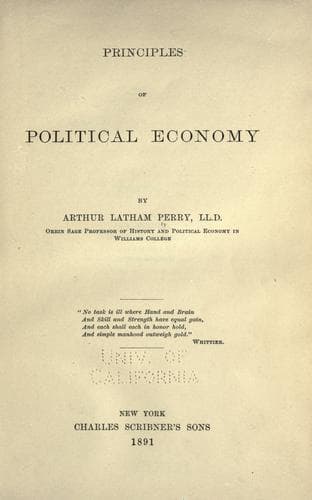
Principles of Political EconomyPerry, Arthur Latham
General
Principles of Political Economy
Perry, Arthur Latham
Economics
Cicero wrote long ago: "Optimum et in privatis familiis et in
republica vectigal est parsimonia." _Abstinence is the best means of
revenue as well in private families as in the State._ The source of
Capital in a distinct act of will saving or sparing from present use
(_parsimonia_) a valuable commodity or credit, and the quick nature of
Capital as adding to itself (_vectigal_) in profits, are both brought
out in this Latin maxim, which is rather an expression of an old and
ingrained Roman sentiment than anything original with Cicero. It is
the very nature as well as the very name of "Capital" to increase
itself by rapid increments. It is as well the Stream as the Source.
For example, any sum of money soon doubles itself when put out at
compound interest, because the original sum increases day and night
until it be repaid. It is of the essence of every form of Capital _to
make growth_, because its sole purpose as such is to become an aid to
future and further production. A trowel in the hands of a mason, which
is capital, pays for itself every day he works with it, and perhaps
every hour of the day, in the increased production wrought by means of
it. The wheel, which free water turns, though a costly implement,
repays that cost a hundred fold in the additional bushels of wheat
turned into flour through its aid as capital. So of all implements. So
of all machinery. So of all means of transportation: ships, canals,
railroads.
There was a strange prejudice in ancient and mediæval times against
this natural increase of capital out of its own bowels, as it were,
owing probably to this dictum of Aristotle: "_For usury is most
reasonably detested, as the increase of our fortune arises from the
money itself, and not by employing it for the purpose for which it was
intended._" In 1360, a French bishop, Nicole Oresme, repeats the error
of Aristotle under the same rhetorical image: "_It is monstrous and
contrary to Nature that a barren stock should give birth, that a thing
sterile in its whole being should fructify and be multiplied from
itself, and such a thing is money._" Even Shakspeare catches up the
old figure: "_Is your gold and silver ewes and rams?_" Shylock
answers: "_I cannot tell; I make it breed as fast._" In the light of
the three requisites of Production, in the light of the purpose and
wisdom of God in arranging the active forces of this world, the
prejudice in question disappears, and intelligence rejoices in the
ever-increasing use of Capital as the handmaid of Labor, in the quick
and sure reward of him who practises abstinence, in the production of
commodities constantly made easier and cheaper in all directions, in a
scale of comforts for the masses of men assuredly rising, in a
divinely appointed force lifting like Christianity itself upon the
otherwise sagging condition of mankind.
Public-domain text, read in full here on John Shaqi.
Reviews
Reviews
No reviews yet
Be the first to share your thoughts on this work.
Elsewhere in the archive
Join the Discussion
Join the discussion
Sign in to leave a comment or review.
Sign InorCreate an account