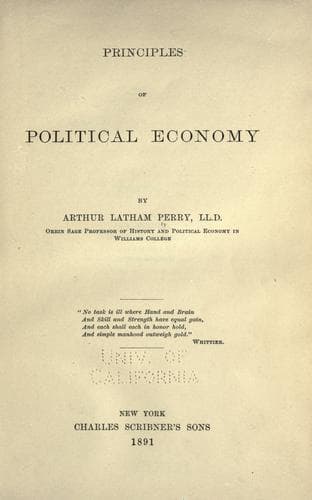
Principles of Political EconomyPerry, Arthur Latham
General
Principles of Political Economy
Perry, Arthur Latham
Economics
(b) Invention. This is the second main condition in the production of
commodities; because production is processes, getting something ready
to sell and selling it; and Nature stands ever ready with her free
agencies to facilitate these processes, just so far as the inventive
brain of man can contrive to unite the two. Invention is the marriage
of a gratuitous force to an onerous process, and the fruit of that
union is an easier way and multiplied utilities. There are some in
every considerable community, and more in every community enlarged by
the natural association but just now described, who have the knack of
contrivance, who find their joy in finding a new power in Nature or
some new application of an old power; were it not for unhindered
association and free exchange, the individuality of these would be
effectually repressed, and they would have to drudge for their daily
bread; but the importance of inventors is well understood in every
progressive community, and under advanced exchanges their livelihood
is guaranteed by those who hope to profit by its results while their
work is maturing; and Production rejoices and grows strong and throws
out unnumbered hands to make instant use of the new power and the
easier processes, in order to multiply commodities in number and
variety.
As an illustration of all this, the reader will be interested in a
brief account of the series of Inventions made in Great Britain during
the last third of the eighteenth century, in consequence of which the
Cotton Industry was established in that country in such preëminence as
has to this day baffled the attempts of all other countries even to
approximate it.
We catch our first glimpse of Cotton in the pages of Herodotus, who
wrote more than 400 years B.C. in relation to India as follows:
"_There are trees, which grow wild there, the fruit whereof is a wool
exceeding in beauty and goodness that of sheep. The natives make their
clothes of this tree-wool._" This passage is interesting, as showing
that the first comparison of cotton with wool exhibited their
resemblance in whiteness and in _kinkiness_, which latter quality
enables them both to be spun into yarn; as showing also, that the
Hindoos very early both spun and wove cotton, and then made it into
clothes; and as showing lastly, the appropriateness of the original
name given to cotton in Europe, namely, "tree-wool," a name by which
the Germans still designate it (Baumwolle). If the extreme East
furnishes the first notice of cotton, the extreme West follows it next
in order. When the Spaniards discovered Central and Southern America
in the first quarter of the sixteenth century, they reported that they
found the Mexicans clothed in cotton cloth.
Public-domain text, read in full here on John Shaqi.
Reviews
Reviews
No reviews yet
Be the first to share your thoughts on this work.
Elsewhere in the archive
Join the Discussion
Join the discussion
Sign in to leave a comment or review.
Sign InorCreate an account