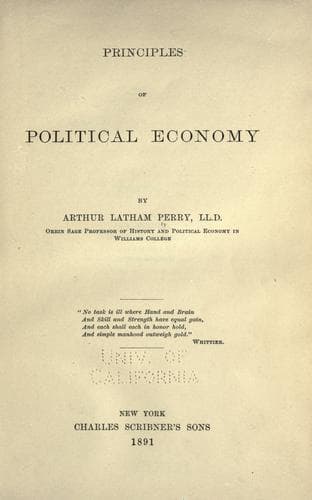
Principles of Political EconomyPerry, Arthur Latham
General
Principles of Political Economy
Perry, Arthur Latham
Economics
But wool was the staple of England. Parliament and people were jealous
of cotton, lest it might prove a rival to wool, and actually
prohibited the introduction of printed calicoes (so called from
Calicut in India whence they were exported). The taste, however, for
calicoes increased in spite of the prohibition, which was afterwards
intermitted for a revenue duty on plain cotton, which was then rudely
printed on blocks in London, Manchester, and elsewhere; but the
prohibition of Parliament against wearing printed calicoes was first
repealed in 1736. Fifteen years later the United Kingdom imported only
2,976,610 lbs. of raw cotton, and exported only £45,986 of cotton
goods; in one century the import of cotton became 500 times larger
than that, and the export of cottons 1300 times larger than that; and
this prodigious result was due mainly to three or four inventions
occurring within short times of each other, by means of which the free
forces of nature took the place of the onerous efforts of men.
John Hargreaves, a poor weaver in the neighborhood of Blackburn in
Lancashire, was returning home from a long walk, in which he had been
purchasing a further supply of yarn for his own loom. Spinning at that
time only admitted of one thread spun at a time by one pair of hands,
one of which turned the wheel and thus made the single spindle rapidly
revolve, and the other hand pulled gently upon the "roving" attached
to the spindle and thus drew it out to the requisite tenuity twisted
into yarn. The "carding," then effected by rude instruments called
hand-cards, by means of which the fibres of the cotton were
disentangled and straightened and laid parallel with each other; and
the "roving," a process by which the short fleecy rolls stripped off
the hand-cards were applied to the spindle and made into thick threads
only slightly twisted, were the two preparatory operations for the
spinning. All these operations were slow and clumsy, and the
consequent expensiveness of the yarn formed a great obstacle to the
establishment of the cotton manufacture in England. The improvements
made in the loom of that period by Kay, father and son, had shortly
before doubled the power of each weaver, and the spinners could not
keep up in furnishing material to the weavers.
Public-domain text, read in full here on John Shaqi.
Reviews
Reviews
No reviews yet
Be the first to share your thoughts on this work.
Elsewhere in the archive
Join the Discussion
Join the discussion
Sign in to leave a comment or review.
Sign InorCreate an account