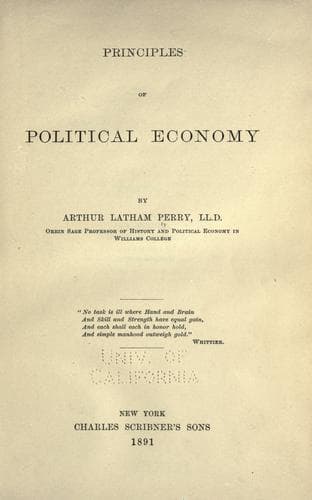
Principles of Political EconomyPerry, Arthur Latham
General
Principles of Political Economy
Perry, Arthur Latham
Economics
In the very year, however, in which John Hargreaves, the poor weaver,
migrated to Nottingham, Richard Arkwright, a poor barber's assistant,
took out a patent for his still more celebrated machine for spinning
by rollers. In one respect Arkwright was much worse off than
Hargreaves: the latter had a helpmate meet for him, the former had a
wife who is said to have destroyed the models her husband had made and
to have opposed him in every step of his career. But Arkwright was not
deterred from his life pursuit by the poverty of his circumstances or
the scandalous conduct of his wife. After many years of intense and
opposed devotion to the possible application of a simple principle he
had conceived in his mind, namely, that of spinning by means of
rollers revolving at varying rates of rapidity, he succeeded in
contriving and patenting his memorable machine, which, more than any
other one invention, localized and concentrated in England the
gigantic cotton-industry of the world. Arkwright's idea and
achievement was to pass the coarse thread drawn out from the rovings
over two pairs of rollers in succession, the first of which revolving
slowly fined the thread down evenly and gradually, and then this
thread was passed over a second pair of rollers turning with a high
velocity and drawing out the line into any requisite tenuity. Thus a
cotton thread was spun capable of being used as warp. Cotton cloth as
such could now be manufactured in England.
From the circumstance that the mill, at which Arkwright's machinery
was first erected, was driven by water power, the machine received the
inappropriate name of the "water-frame"; and the thread spun on these
rollers was commonly called the "water-twist." The old mode of carding
the cotton by hand now furnished the "rovings" too slowly to meet the
wants of the new spinning-jenny and the new water-frame; and these
great inventions would consequently have proven comparatively useless,
had not a more efficient and rapid process of carding the cotton
superseded just at the right time the old system of hand-carding.
Lewis Paul introduced revolving cylinders for carding the raw cotton
into rovings preparatory to spinning, in partial imitation perhaps of
Arkwright's principle of spinning the rovings by the rotatory motion
of rollers. Paul's machine consisted "_of a horizontal cylinder,
covered in its whole circumference with parallel rows of cards with
intervening spaces, and turned by a handle. Under the cylinder was a
concave frame, lined internally with cards exactly fitting the lower
half of the cylinder, so that when the handle was turned, the cards of
the cylinder and of the concave frame worked against each other and
carded the wool. The cardings were of course only of the length of the
cylinder, but an ingenious apparatus was attached for making them into
a perpetual carding. Each length was placed on a flat broad riband,
which was extended between two short cylinders, and which wound upon
Public-domain text, read in full here on John Shaqi.
Reviews
Reviews
No reviews yet
Be the first to share your thoughts on this work.
Elsewhere in the archive
Join the Discussion
Join the discussion
Sign in to leave a comment or review.
Sign InorCreate an account