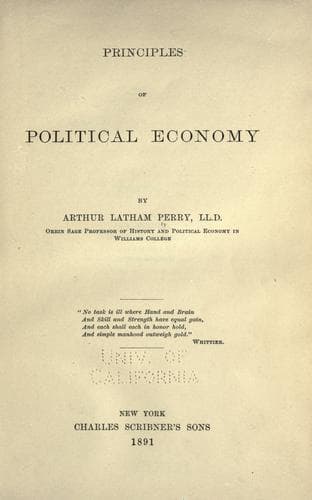
Principles of Political EconomyPerry, Arthur Latham
General
Principles of Political Economy
Perry, Arthur Latham
Economics
As Hargreaves entered his cottage from this excursion to get yarn to
keep his loom agoing, his wife, Jenny, accidentally upset the spindle,
which, as was her wont, she was diligently using. Her husband noticed
that the spindle, which was now thrown into an upright position,
continued to revolve just as when horizontal, and that the thread was
still spinning in his wife's hands. The idea immediately occurred to
him, that it might be possible to connect a considerable number of
upright spindles with the revolutions of one wheel, and thus multiply
the power of each spinster. "_He contrived a frame in one part of
which he placed eight rovings in a row, and in another part a row of
eight spindles. The rovings, when extended to the spindles, passed
between two horizontal bars of wood, forming a clasp which opened and
shut somewhat like a parallel ruler. When pressed together this clasp
held the threads fast; a certain portion of roving being extended from
the spindles to the wooden clasp, the clasp was closed, and was then
drawn along the horizontal frame to a considerable distance from the
spindles, by which the threads were lengthened out and reduced to the
proper tenuity; this was done with the spinner's left hand, and his
right hand at the same time turned a wheel which caused the spindles
to revolve rapidly, and thus the roving was spun into yarn. By
returning the clasp to its first situation and letting down a piercer
wire the yarn was wound upon the spindle._"
The powers of Hargreaves' machine soon became known among his ignorant
neighbors, notwithstanding his strenuous efforts to keep his admirable
invention a secret, and these neighbors naturally enough concluded
that a contrivance, which enabled one spinster to do the work of
eight, would throw many people out of employment. A mob broke into his
house and destroyed his machine. Hargreaves retired in disgust to
Nottingham, where by means of the friendly assistance of one other
person he was enabled to take out a patent for his invention, which he
called in compliment to his industrious wife the "_Spinning-Jenny_."
This invention gave a new impulse to the cotton manufacture, but had
it been unaccompanied by other improvements, no purely cotton goods
could have been made in England; because the yarn spun by the new
jenny, like that previously spun by hand, was not fine enough nor hard
enough to be used as warp, and linen or woollen threads had
consequently to be employed for that purpose.
Public-domain text, read in full here on John Shaqi.
Reviews
Reviews
No reviews yet
Be the first to share your thoughts on this work.
Elsewhere in the archive
Join the Discussion
Join the discussion
Sign in to leave a comment or review.
Sign InorCreate an account