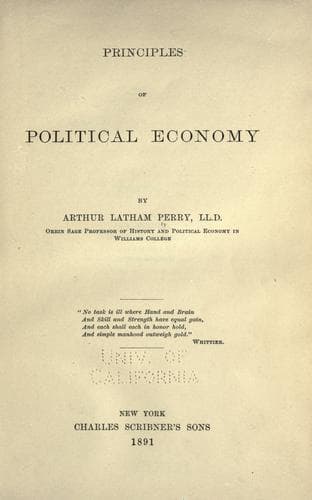
Principles of Political EconomyPerry, Arthur Latham
General
Principles of Political Economy
Perry, Arthur Latham
Economics
In what cases may a Government properly step in to regulate or
prohibit the buying and selling of its citizens? Hundreds of
inductions extending through hundreds of years have been carefully and
logically conducted in order to reach a just and comprehensive answer
to this question; and in all probability the cases have been
inductively ascertained for all time, and they are these: _such buying
and selling may be controlled and prohibited, as are proven to be
contrary_ (1) _to the public Morals_, (2) _to the public Health_, (3)
_to the public Revenue_. All other buying and selling may be safely
assumed to be both profitable to the parties to it, and also useful to
the Commonwealth in general; and any interference with it by public
authority is a high-handed infringement of natural rights, a blow
aimed at the life and source of property. These wrongful strokes at
private rights, this restriction on the freedom of individuals to
exchange products for their own welfare, is now mostly confined in
civilized countries to the region of Taxation. Within this region the
wrongs are still frightful. Judge Cooley, in his "Principles of
Constitutional Law," states the matter as follows: "_Constitutionally
a tax can have no other basis than the raising of revenue for public
purposes; and whatever governmental action has not this basis is
tyrannical and unlawful. A tax on imports, therefore, the purpose of
which is not to raise a revenue, but to discourage and indirectly
prohibit some particular import for the sake of some home
manufacturer, may well be questioned as being merely colorable, and
therefore not warranted by constitutional principle._"
Public-domain text, read in full here on John Shaqi.
Reviews
Reviews
No reviews yet
Be the first to share your thoughts on this work.
Elsewhere in the archive
Join the Discussion
Join the discussion
Sign in to leave a comment or review.
Sign InorCreate an account