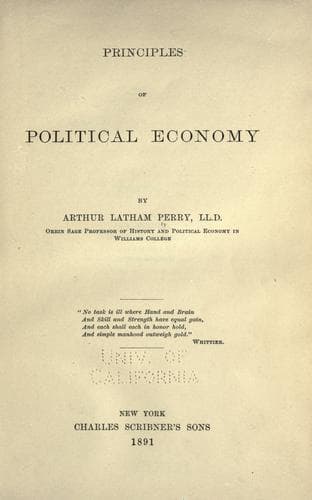
Principles of Political EconomyPerry, Arthur Latham
General
Principles of Political Economy
Perry, Arthur Latham
Economics
Formerly, governments interfered almost beyond belief with the freedom
of their people in all industrial and commercial action; dictating
what should and what should not be grown and manufactured, what should
and what should not be exported and imported; decreeing by
proclamation or enacting by statute, the number of apprentices each
artisan might employ, and the years during which these must serve as
such, and the conditions under which they might then work as
journeymen; the materials to be used in woven fabrics, and even the
widths and other minor features of such fabrics, were prescribed in
the foremost of the European nations; in the reign of St. Louis of
France, a "Book of Trades" was issued under royal authority and is
still extant, which organizes minutely and subjects to cumbersome
rules more than one hundred separate industries as then practised;
England was the country of the great trading "Companies," and of all
of these the same may be said as Adam Smith said of the Turkey Company
formed in 1579, namely, it was "a strict and oppressive monopoly";
among others there were the African Company established in 1530, the
Russia Company beginning its operations in 1553, the East India
Company chartered on the very last day of the seventeenth century and
going out of existence in our own time, and the Hudson's Bay Company,
chartered in 1670 and so having the sole control in trade of a region
forty times larger than all England; while the colonial system
prevailing for two centuries in all the countries of Western Europe
regulated the commerce and controlled the manufactures in the colonies
with a single eye to the benefits of the mother country, as those were
conceived of under the wretched Mercantile system.
Happily, since governments have become more enlightened than formerly,
they are perceiving for the most part that they have not the least
right to interfere in those ways or in any ways with the natural right
of their people to make and grow freely all material commodities, and
to buy and sell these freely in the best markets wherever these
markets are to be found; and they are also perceiving, that by such
interference incalculable losses of property and indefinite
retardations of progress are caused to their people, as well as
weakness to themselves as governments through a more difficult
gathering of taxes and a harder maintenance of prestige and power.
Public-domain text, read in full here on John Shaqi.
Reviews
Reviews
No reviews yet
Be the first to share your thoughts on this work.
Elsewhere in the archive
Join the Discussion
Join the discussion
Sign in to leave a comment or review.
Sign InorCreate an account