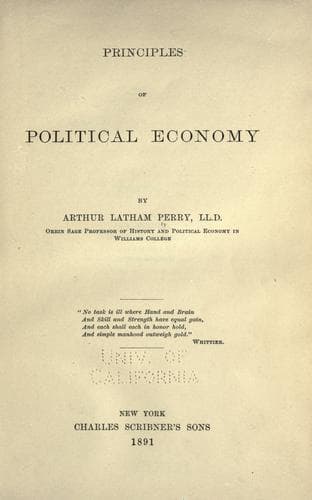
Principles of Political EconomyPerry, Arthur Latham
General
Principles of Political Economy
Perry, Arthur Latham
Economics
tell exactly how they will be divided. Two things about it, however,
are _certain_ at least in their tendencies and potencies. The
blacksmith is sure to get some part of the extra fruit of his
neighbor's new push and spirit, while the tailor is sure to get as his
own reward by much the larger part of the whole blessed 11.
We must by no means omit to notice the logical inference from this
instance, nor fail to make the proper inductive generalization from a
sufficient number of similar instances. It is this: no man can make
any essential improvement in any of the methods of producing material
commodities, without at the same time benefiting other people as well
as himself. Under natural law, which is no respecter of persons, he
can by no possibility selfishly take to himself the entire fruits of
his own growing skill and vigor. The only way in which he can gather
in at all the fruits of these is to sell their proceeds in the open
market. To broaden his own market for now better and more abundant
goods he must offer them to everybody on somewhat better terms than
formerly--and the better the terms the broader the market--and he can
well afford to do this, because the goods now cost him less of irksome
human effort. Every improvement in the production of commodities is
precisely of that complexion. The issue of every invention, of every
improved process of every kind, is, so far forth, a cheaper product.
And this public gain follows, must follow, individual enterprise at
single points, even when the great mass of exchangers remain at the
old stage of sluggishness. Whatever increases at one point even, and
_a fortiori_ at two points, the diversity of relative advantage as
between any two exchangers, is of benefit to them both, and the
greater this relative diversity becomes the greater the benefit to
both.
Public-domain text, read in full here on John Shaqi.
Reviews
Reviews
No reviews yet
Be the first to share your thoughts on this work.
Elsewhere in the archive
Join the Discussion
Join the discussion
Sign in to leave a comment or review.
Sign InorCreate an account