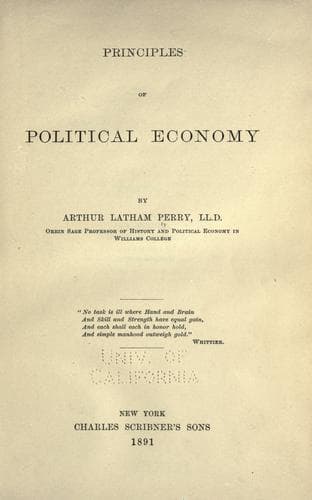
Principles of Political EconomyPerry, Arthur Latham
General
Principles of Political Economy
Perry, Arthur Latham
Economics
Now let us see how the matter stands, when tailor and blacksmith at
the same time feel and obey the impulses to a more skilled and
vigorous artisan life. Suppose the blacksmith too carries up his
efficiency in his own trade to 15, just as the tailor has done, the
potency of each in the trick of the other remaining as before at 5;
under these circumstances when the two come to trade with each other,
each has a relative superiority over the other of 10, and there is an
advantage of 20 points to be divided between the two; the trade is now
ten times more profitable to each than it was at the outset, when
there was only an aggregate of 2 units for the division between two
parties; and accordingly the motive to an exchange and the gain of an
exchange as between tailor and blacksmith are ten times greater than
they were before. Therefore we lay down the principle, as inductively
ascertained and as universally applicable to all exchanges, that the
greater the relative superiority at different points as between the
parties exchanging, the more beneficial and profitable do the
exchanges become to all the participators in them. If this principle
be just, and we may well flatter ourselves that it will be found to be
just, it follows, that every man who has anything to buy or sell, is
directly interested in the highest success of his fellow-exchangers,
that every trade finds its own advantage in the success of all other
trades, and that all discoveries and inventions by which Nature is
made to pay tribute to art is, restrictions apart, so much clear gain
to the world at large. In the light of sound and broad principles,
what David Hume called the "Jealousy of Trade" is simply silly.
The mainspring that impels all buyers and sellers to quicken their
movements and to improve their methods and thus and otherwise to
cheapen their costs of production, is the natural press of
_competition_. Somebody else is offering this product, or will offer
it, for less than we are now selling it for, and we must contrive
some way by shortened times or cheaper processes or a quicker zeal not
to be beaten in this market-race, is the silent argument ever making
itself felt on the mind and hand of the producer. Such natural action
always increases the general diversity of relative advantage as among
buyers and sellers.
Public-domain text, read in full here on John Shaqi.
Reviews
Reviews
No reviews yet
Be the first to share your thoughts on this work.
Elsewhere in the archive
Join the Discussion
Join the discussion
Sign in to leave a comment or review.
Sign InorCreate an account